





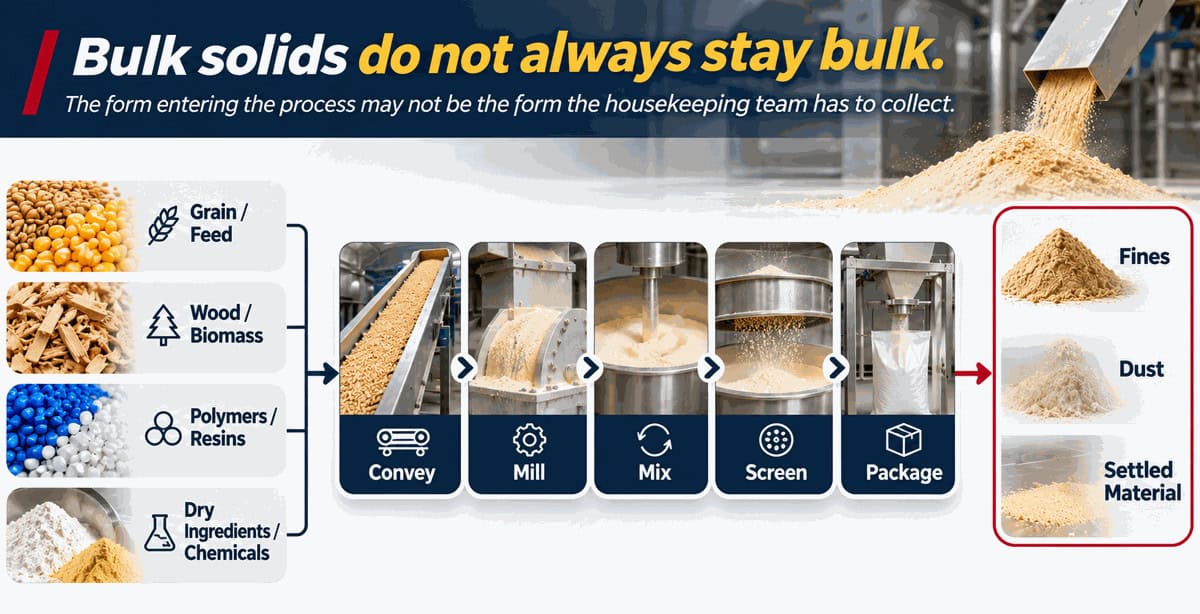
Bulk materials do not always stay in the form in which they arrive.
A facility may receive material as grain, pellets, granules, meal or powder. Conveying, milling, mixing, screening, filling and packaging can generate finer particulates as that material moves through the process.
Grain dust may settle beneath a conveyor or elevator. Feed meal and pellet fines collect around mixers and screens. Wood and biomass processing generates sawdust and fine fibers. Polymer pellets and granules can produce plastic fines, while resin and ingredient handling may start with powders from the beginning.
Some of that dust should be captured while it is airborne. Some still end up on equipment, floors, platforms, structural surfaces and hard-to-reach areas.
That is where housekeeping becomes a separate equipment question.
And when the material is combustible, selecting the vacuum starts with something more important than horsepower or airflow:
Where is the vacuum actually being used?
Ordinary Location Does Not Mean Ordinary Vacuum
The 2025 edition of NFPA 660, Standard for Combustible Dusts and Particulate Solids, makes an important distinction between combustible material and the classification of the area where equipment is being used.
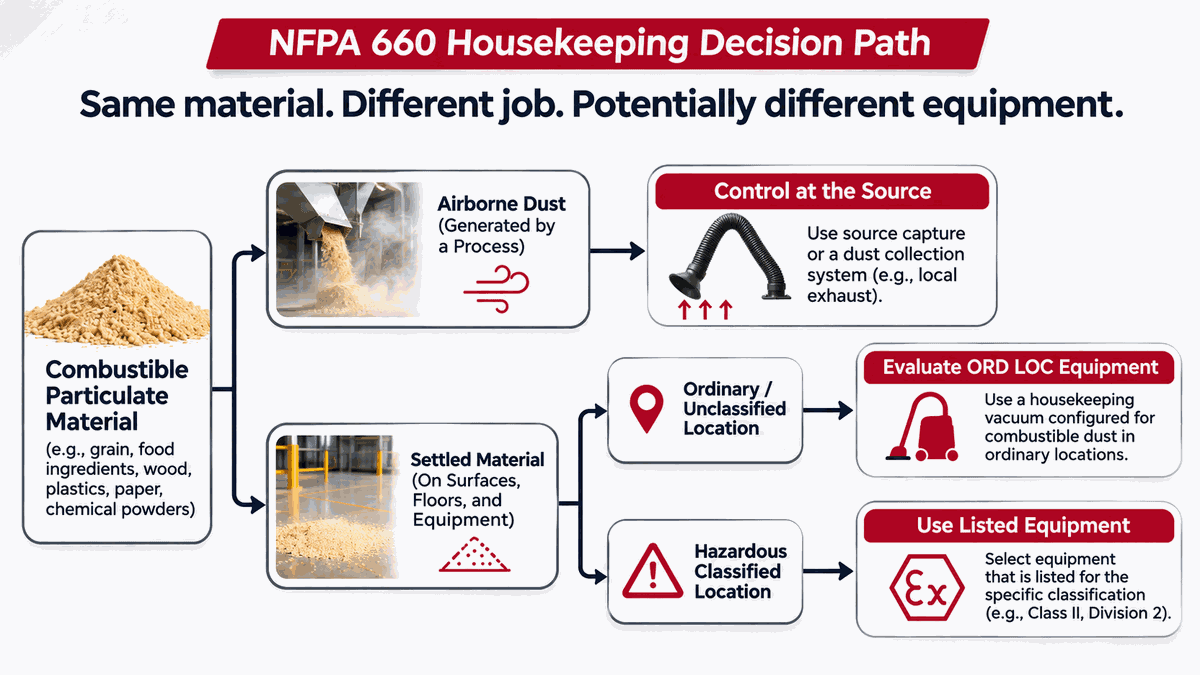
A facility can handle combustible particulate solids without every room, process area or housekeeping point automatically becoming a hazardous classified location.
NFPA 660 addresses portable vacuum cleaning differently depending on the application and location.
Section 8.4.2.2.1.8 provides a pathway for electric portable vacuum cleaners collecting combustible particulate solids in unclassified locations. Section 8.4.2.2.1.10 addresses combustible-dust hazardous classified locations, where the vacuum must be listed for the applicable hazardous location.
That distinction matters.
The vacuum does not determine whether the area is classified. The facility’s hazard assessment, material properties, release conditions, process design and documented electrical classification do.
OSHA uses the same location-specific principle in 29 CFR 1910.307, which states that each room, section or area is considered individually when determining hazardous classification.
So a grain mill, food plant, feed facility, wood processor, plastics operation or chemical plant can have different equipment requirements in different parts of the same facility.
The material matters. So does the location.
What Changes About the Vacuum Under NFPA 660?
An ordinary-location combustible-dust vacuum is not simply a standard industrial vacuum with an antistatic filter installed.
NFPA 660 considers the complete pickup system.
For portable electric vacuums collecting combustible particulate solids in qualifying unclassified locations, the equipment path includes factors such as conductive or static-dissipative hose, bonding and grounding of conductive components, appropriate tools and attachments, filtration safeguards and the relationship between the primary filtration and the fan or blower.
That means the hose and accessory package should be treated as part of the vacuum specification rather than something selected after the machine arrives.
Filtration is only one part of the system.
An antistatic primary filter can be important, but it does not replace proper bonding and grounding. Likewise, HEPA filtration can address finer-particle retention requirements, but HEPA does not change the electrical classification of the area or convert an ordinary-location vacuum into hazardous-location equipment.
The application still has to be evaluated as a complete system.
NFPA 660 also establishes boundaries around portable-vacuum use. Hot embers and sparks are a different application. Combustible metals require additional consideration. Material quantity matters. And a major bulk spill should not automatically be treated the same way as normal residual housekeeping.
One useful design point is dirty-side volume.
NFPA 660 introduces additional explosion-protection and isolation provisions when the dirty-side volume of a portable vacuum exceeds 8 ft³ (0.2 m³).
The documented dirty-side volume of the Depureco M100 ORD LOC is below that threshold.
That fact alone does not determine compliance. It is one engineering consideration within the complete application.
Airborne Dust and Settled Dust Are Different Jobs
A portable industrial vacuum is a housekeeping tool. It should not be asked to replace source capture.
Dust generated while an operator empties a bag or FIBC, while material transfers between conveyors, while a mixer is charged or while powder enters a filling or packaging line may require local exhaust or dedicated dust collection at the point of generation.
Housekeeping begins with the material that still escapes normal process containment.
Consider a mixer.
Dust released during charging may require source capture. Repeated leakage from a seal is a process problem that should be corrected. Material that settles afterward around the mixer frame, platform and surrounding floor is a housekeeping problem.
The same distinction appears around bag dumps, feeders, mills, sifters, screens, conveyors, elevators, silos and packaging equipment.
A larger housekeeping vacuum cannot compensate for uncontrolled airborne dust generation.
But once the process controls have done their job, a properly selected industrial vacuum can remove settled material without redistributing it through sweeping or compressed-air cleaning.
The vacuum therefore becomes part of the overall dust-control strategy—not a replacement for it.
Different Bulk Materials Create Different Cleanup Loads
“Combustible dust” is a hazard category. It is not one material.
Actual housekeeping loads can behave very differently.
Grain, flour, starch and powdered ingredients can be extremely fine and readily dispersed. Feed plants may generate meal, premix dust and fines produced from pellets during conveying and handling.
Wood and biomass operations can create sawdust, wood flour, fibers and pellet fines.
Plastics processing introduces another group of materials. A process may handle relatively free-flowing pellets or granules while also generating polymer dust, resin powder, regrind fines or static-prone particulate during transfer, grinding, blending and packaging.
Chemical, pharmaceutical and nutraceutical powders can introduce additional concerns such as toxicity, conductivity, corrosion, containment or cross-contamination.
Those differences affect filter loading, hose selection, pickup tools, collection capacity, disposal method and how frequently the vacuum needs to be serviced or emptied.
They are also why vacuum selection should begin with the actual material and process—not simply the words “combustible dust.”
How Much Portable Vacuum Does the Cleanup Actually Need?
Once the material and location are understood, the next question is operational:
How much machine does the housekeeping job actually require?
If an operator is cleaning one bag dump, one mixer, a screening station, packaging equipment or several nearby process points, a compact machine may be easier to move and easier to position around production equipment.
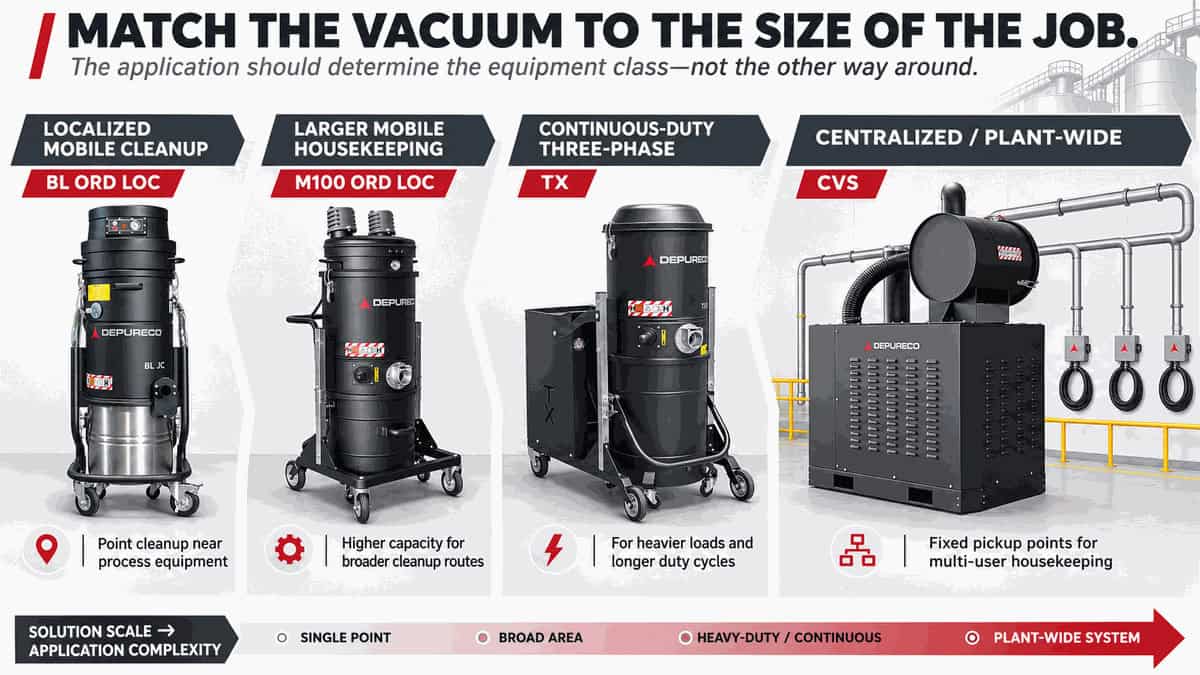
That is where the Depureco BL ORD LOC range fits.
The family includes portable configurations such as the BL PRO ORD LOC, BL20 JC ORD LOC, BL45 ORD LOC and BL45 JC ORD LOC.
They cover the compact end of ordinary-location combustible-dust housekeeping where mobility and footprint matter.
The differences within the range are practical.
The BL20 JC uses a compact collection format with a large cartridge filtration surface and JetClean filter cleaning. The BL45 provides more collection capacity with manual filter cleaning. The BL45 JC combines the larger collection format with cartridge filtration and JetClean for applications where fine material loads the filter more frequently.
The choice is not simply based on the largest motor.
It depends on material volume, available floor space, filter loading, cleanup frequency and how the operator needs to move through the plant.
When the operator is cleaning a larger process area or several pieces of equipment before the machine is emptied, the M100 ORD LOC moves into a different operating range.
Its current configuration provides 336 CFM, a 26-gallon detachable collection bin and standard 120 V single-phase power.
In practical terms, that provides more airflow for broader floor-cleaning tools and larger cleanup areas, more material capacity between dumps, and the ability to move between normal facility power points without immediately moving into three-phase equipment.
Localized cleanup → BL ORD LOC
Larger mobile housekeeping → M100 ORD LOC
Sometimes the Collection System Matters as Much as the Vacuum
In bulk-solids handling, the limiting factor is not always suction power.
Sometimes it is the amount of material being recovered—and what has to happen to that material afterward.
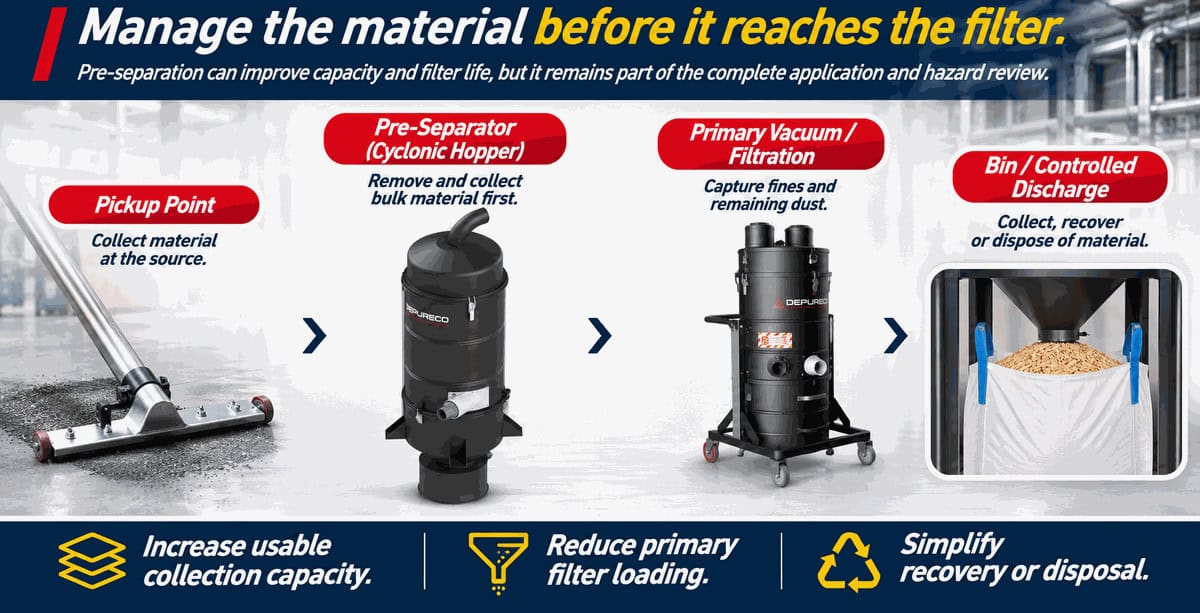
A pre-separator or filtering interceptor can be incorporated where an application needs additional collection volume, separation before material reaches the primary vacuum, reduced filter loading or a different recovery and disposal workflow.
Depending on the job, that can include cyclonic or tangential separation, larger detachable collection containers, high-volume pre-separators, tiltable bins or other discharge arrangements.
This becomes especially useful where the vacuum is recovering meaningful volumes of bulk material rather than only a light layer of dust.
But these components are not stand-alone combustible-dust “compliance accessories.”
When they become part of the pickup and collection system, the material properties, area classification, grounding and bonding strategy, system volume, operating conditions and dust hazard analysis still need to be considered as part of the complete application.
When Does a Portable Vacuum Stop Making Sense?
Portable single-phase equipment is useful precisely because it can move with the operator.
There is a point, however, where mobility stops being the advantage.
If operators are emptying the machine constantly, using long hose runs, cleaning large portions of a facility every shift, recovering heavier volumes of material or operating for extended periods under load, the job may have moved beyond a compact single-phase vacuum.
A continuous-duty three-phase industrial vacuum can provide the next step for longer operating cycles and higher material loads while remaining mobile.
When the same cleanup points are used every day—or when multiple floors, production areas or operators need suction—the application may be better suited to a stationary or centralized vacuum system.
The same boundary applies in the other direction.
If dust is continuously escaping from a transfer point while the process is running, the answer may be better source capture rather than more housekeeping labor.
And if the cleanup location is documented as a combustible-dust hazardous classified area, the ordinary-location pathway no longer applies.
The equipment has to match the documented classification.
Specify the Application, Not Just the Vacuum
For combustible-dust housekeeping, a useful RFQ contains much more information than:
“We need an explosion-proof vacuum.”
The supplier needs to understand:
what material is being collected;
whether it is powder, dust, fines, granules, pellets or mixed bulk material;
particle behavior and relevant combustible-dust properties;
how much material is collected;
whether the problem is airborne or settled;
the documented area classification;
how frequently the system will operate;
hose length and pickup-tool requirements;
whether pre-separation is needed; and
how the recovered material will be discharged or disposed of.
That information determines whether the application belongs with a compact portable vacuum, a larger single-phase unit, a three-phase machine, listed hazardous-location equipment or an engineered central system.
NFPA 660 provides a clearer basis for making that distinction.
For qualifying ordinary or unclassified locations, portable combustible-dust housekeeping has its own equipment path.
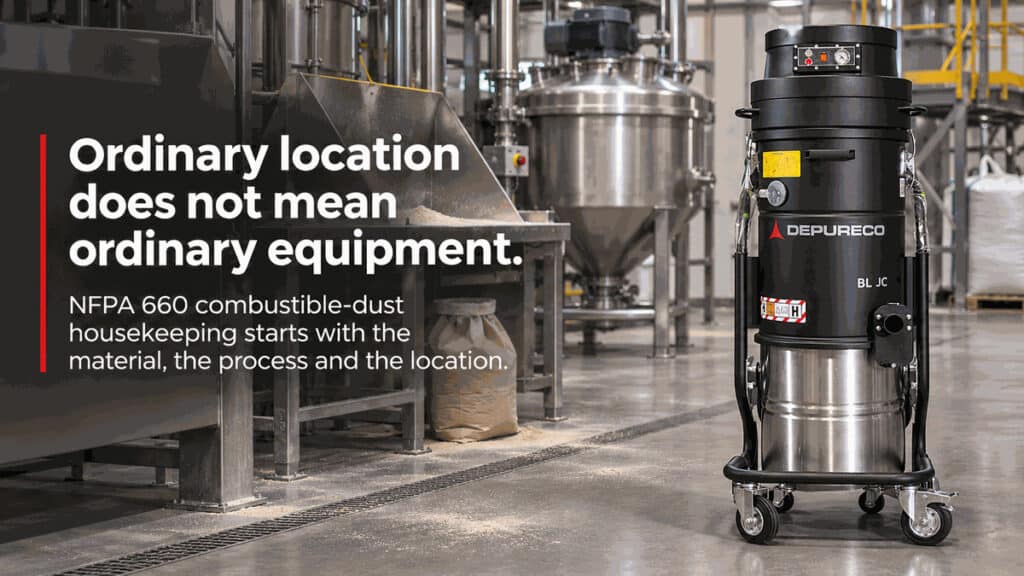
Ordinary location does not mean ordinary equipment.
It means selecting and configuring the vacuum around the actual material, process and location where cleanup occurs.
From Portable Housekeeping to an Engineered Plant-Wide System
Depureco USA’s BL ORD LOC range and M100 ORD LOC provide portable single-phase options for this portion of the housekeeping spectrum. Final configuration should be based on the facility’s material, area classification, housekeeping procedure, operating duty and dust hazard analysis.
Portable equipment, however, is only one part of the solution.
As material volume and operating duty increase, Depureco can extend the same application review into continuous-duty three-phase vacuums, larger pre-separation and collection systems, stationary vacuum units, permanent piping networks and complete industrial central vacuum systems.
A central system can be engineered around the number of pickup points, simultaneous users, conveying distance, airflow, vacuum level, pipe diameter, filtration, material separation and discharge method rather than forcing the entire plant into the limitations of a portable machine.
For combustible-dust applications, larger engineered systems can also incorporate application-specific protection and control strategies where required.
Depending on the material, installation and DHA, these can include explosion venting, flameless venting, passive or active isolation devices, explosion suppression, conductive system components, grounding strategies, controlled material discharge, level sensing, automatic filter cleaning and electrical or remote system controls.
The applicable protection method is application-specific. System design may need to consider NFPA 660, NFPA 68 for deflagration venting, NFPA 69 for explosion prevention, isolation and suppression, hazardous-location electrical requirements and other standards relevant to the facility.
The objective is not to make every application use the same protection package.
It is to engineer the complete collection path—from the pickup point through separation, filtration and discharge—around the actual process risk.
That broader range allows Depureco to support the application from a compact portable housekeeping vacuum to a three-phase machine or fully engineered plant-wide recovery system without treating every dust problem as the same equipment problem.
For facilities reviewing combustible-dust housekeeping under NFPA 660, expanding an existing recovery system or deciding where portable equipment stops making sense, Depureco USA can review the material, process, pickup points, area classification, collection volume and operating requirements to help determine the appropriate vacuum or engineered system configuration.
References & Further Reading
NFPA 660 — Standard for Combustible Dusts and Particulate Solids, 2025 Edition
NFPA 68 — Standard on Explosion Protection by Deflagration Venting
NFPA 69 — Standard on Explosion Prevention Systems
OSHA — 29 CFR 1910.307: Hazardous (Classified) Locations
OSHA — Revised Combustible Dust National Emphasis Program, CPL 03-00-008
Depureco USA — NFPA 660 Vacuum Requirements for Combustible Dust Cleanup
Depureco USA — BL20 JC ORD LOC
Depureco USA — BL45 JC ORD LOC
Depureco USA — Industrial Vacuum Pre-Separators & Cyclone Interceptors