

Why combustible dust cleanup requires ATEX-certified explosion-proof industrial vacuum cleaners, not shop-type vacuums.
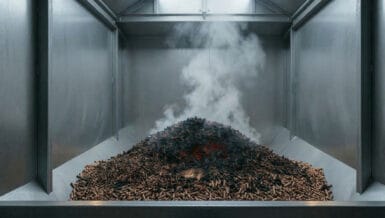
In facilities that process, package, convey, blend, mill, weigh, or handle dry bulk powders, combustible dust is more than a housekeeping issue. It is a process safety concern. Fine dusts from food ingredients, chemicals, plastics, pharmaceuticals, nutraceuticals, agricultural products, metal powders, carbon-based materials, and other industrial materials can accumulate on floors, machinery, overhead beams, ledges, walls, and hard-to-reach surfaces. When disturbed, that dust can become airborne. When suspended in the right concentration and exposed to an ignition source, it can contribute to a flash fire or dust explosion.
That is why combustible dust housekeeping must be treated as part of a facility’s explosion protection strategy, not as a routine cleanup task assigned to whatever vacuum cleaner is nearby.
VAC-U-MAX CD Series explosion-proof combustible dust vacuum cleaners are engineered for this exact challenge. Designed for the high-volume cleanup of fine powders and combustible dusts, the CD Series provides ATEX-certified, compressed-air-powered industrial vacuum-cleaning solutions for hazardous dust collection applications where ordinary vacuum cleaners are not appropriate.
Why Shop-Type Vacuums Do Not Belong in Combustible Dust Areas
A shop-type vacuum cleaner may look harmless. It may be inexpensive, easy to find, and familiar to maintenance teams. But when combustible dust is present, the wrong vacuum cleaner can create risk instead of reducing it.
Shop-type vacuum cleaners are generally not designed for hazardous dust collection. Many use electric motors, standard switches, non-conductive plastic components, non-conductive hoses, and filters that are not intended to safely contain fine combustible powders. During operation, dust moving through a hose can generate static charge. If the vacuum, hose, drum, tools, or operator are not properly grounded and bonded, static discharge can become a potential ignition source.
Another problem is dust control. Fine powders can challenge ordinary filters, leak from collection systems, or be discharged back into the work environment. Instead of removing the hazard, an improper vacuum cleaner can create dust clouds, redistribute dust, and contribute to the same conditions combustible dust housekeeping is meant to prevent.
For combustible dust, “better than sweeping” is not enough. The equipment must be designed for the hazard.
Combustible Dust Safety Starts with Removing the Fuel Source
Dust explosion prevention is often discussed in terms of ignition control, suppression, containment, venting, and isolation. Those are critical elements of a larger process safety program. But one of the most practical steps a facility can take is controlling the fuel source: fugitive dust.
Combustible dust accumulations on overhead surfaces, equipment, beams, cable trays, floors, ledges, and structural beams can become dangerous when disturbed by vibration, equipment movement, compressed air, sweeping, maintenance activity, or a primary event elsewhere in the facility. In a secondary explosion scenario, settled dust becomes airborne, ignites, and can create a destructive chain reaction.
A proper vacuum-cleaning program helps reduce the amount of available fugitive dust before it becomes a larger hazard. Unlike sweeping or blowing, which can push dust into the air or move it from one location to another, an industrial combustible dust vacuum cleaner is designed to capture, contain, and remove dust from the process area.
VAC-U-MAX CD Series: Built for Combustible Dust Collection
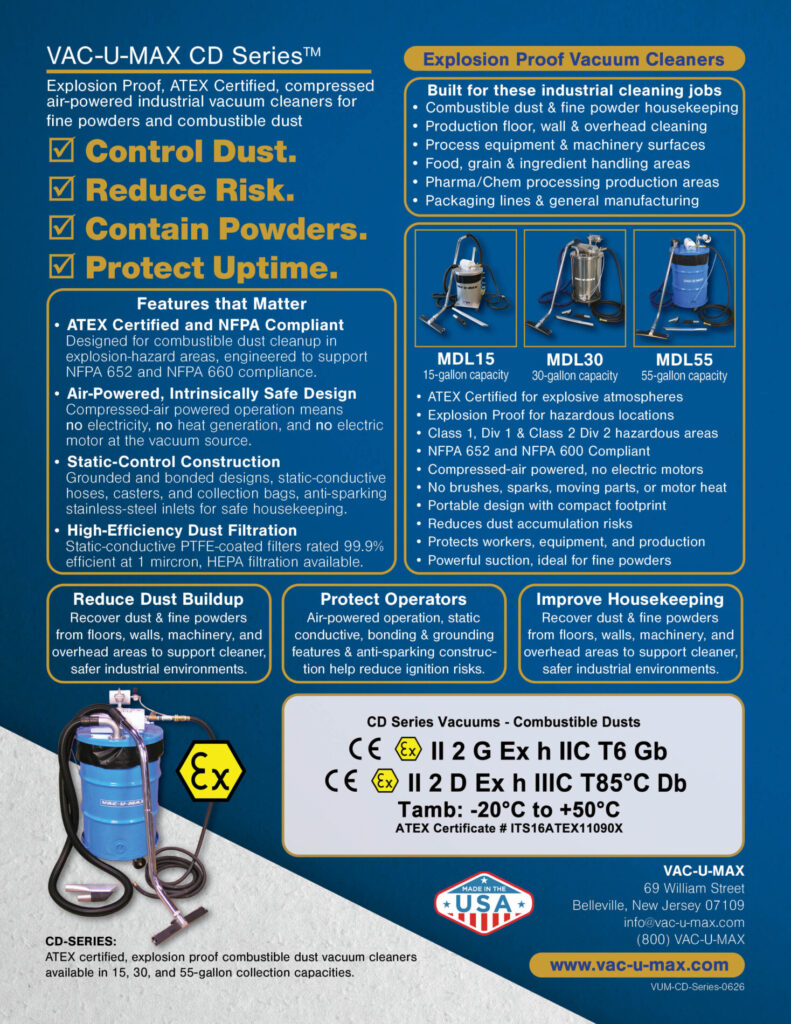
VAC-U-MAX CD Series explosion-proof combustible dust vacuum cleaners are ATEX-certified and compressed-air powered. Because they are air operated, they do not use electricity during operation and do not generate operational heat from an electric motor. This design helps reduce ignition concerns associated with electrical components in combustible dust environments.
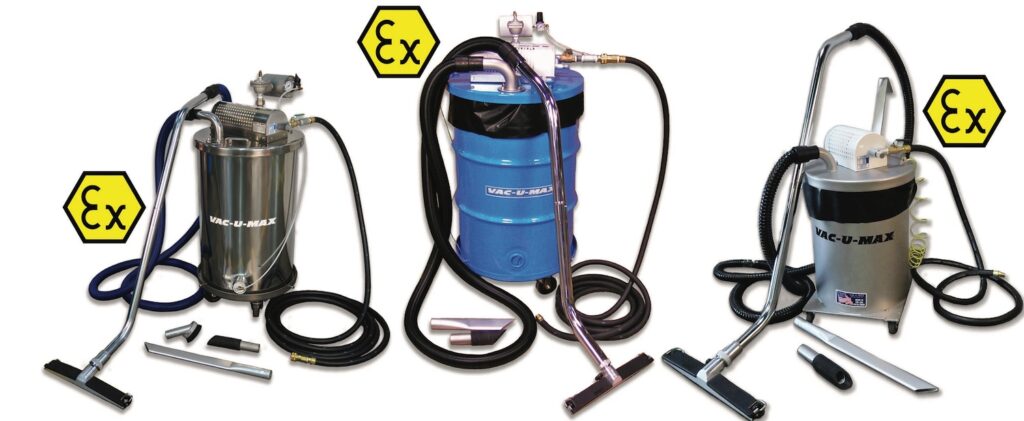
The CD Series is available in a range of sizes and collection capacities to support different housekeeping requirements, plant layouts, and material volumes, including:
15-gallon CD Series vacuum – a compact option for combustible dust cleanup where portability and lower collection volume are required.
30-gallon CD Series vacuum – a mid-size solution for production areas, packaging lines, processing rooms, and routine combustible dust housekeeping.
30-gallon stainless steel CD Series vacuum – suited for applications where stainless construction is preferred for sanitation, corrosion resistance, or material compatibility.
55-gallon single venturi CD Series vacuum – a higher-capacity option for larger cleanup requirements and heavier routine use.
55-gallon twin venturi CD Series vacuum – designed for increased performance where greater airflow and vacuum capacity are needed for demanding combustible dust collection tasks.
This range allows facilities to select the right vacuum cleaner based on the material being collected, dust volume, housekeeping frequency, area classification, production environment, and operator requirements.
Grounding, Bonding, and Static Control Matter
Combustible dust safety depends on controlling ignition sources. Static electricity is one of the most overlooked hazards during vacuum cleaning. When fine powders move through hoses, wands, filters, and collection drums, static can build quickly if the system is not properly designed.
VAC-U-MAX CD Series vacuum cleaners are engineered with combustible dust collection in mind, including grounded and bonded design features that support safer vacuum operation in hazardous dust applications. For facilities evaluating combustible dust vacuum cleaners, grounding and bonding should not be an accessory or afterthought. It should be part of the system design.
That includes the vacuum head, drum, hose, tools, filters, casters, compressed-air line, and grounding connection. A combustible dust vacuum cleaner is not just a suction device. It is a safety system.
Housekeeping Is Part of Explosion Protection
Explosion protection often brings to mind suppression, explosion vents, flameless venting, isolation valves, containment-rated equipment, and engineered controls. These systems play an important role in protecting people, equipment, and facilities. But combustible dust prevention begins much earlier.
Routine removal of fugitive dust helps reduce the likelihood that dust accumulations will become fuel for a flash fire or secondary explosion. A well-designed housekeeping program supports compliance, reduces risk, improves plant cleanliness, and can contribute to a safer work environment for operators, maintenance teams, sanitation crews, and production personnel.
In many plants, combustible dust is generated every day through normal operations. Filling, dumping, mixing, packaging, conveying, milling, screening, and transfer points can all release dust. Even small leaks and minor spills can become larger hazards when they accumulate over time. The right vacuum-cleaning system gives facilities a practical way to manage that risk.
Do Not Let Cleanup Create the Hazard
Using a shop-type vacuum cleaner in a combustible dust environment may seem like a quick fix, but it can introduce serious safety concerns. The wrong vacuum can create static, sparks, heat, poor filtration, dust clouds, and uncontrolled discharge. In combustible dust applications, cleanup equipment must be selected with the same level of care as process equipment.
VAC-U-MAX CD Series explosion-proof combustible dust vacuum cleaners provide an ATEX-certified, industrial-grade solution for facilities that need to safely remove fine powders and combustible dusts from floors, machinery, walls, overhead areas, and production spaces. With multiple collection capacities and air-powered operation, the CD Series helps manufacturers strengthen their combustible dust housekeeping programs while supporting broader explosion protection and process safety goals.
When the material being cleaned can burn, flash, react, or explode, the vacuum cleaner matters.
Choose equipment designed for the hazard. Choose combustible dust vacuum cleaning systems engineered for industrial safety. Choose VAC-U-MAX CD Series.