


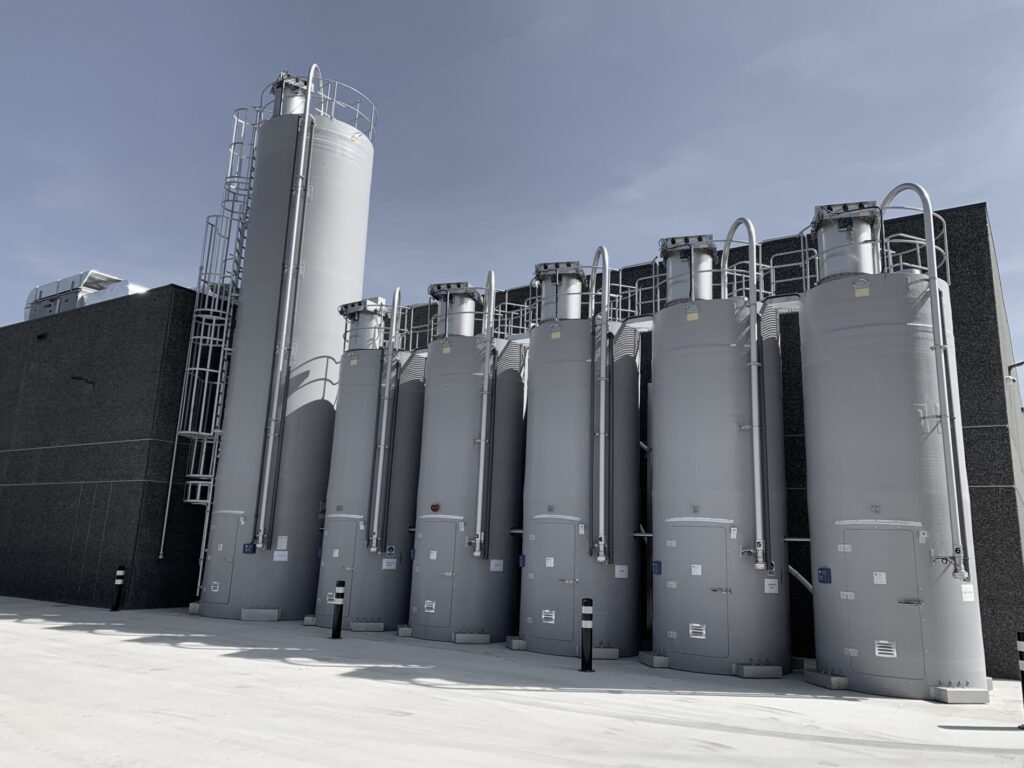
Designing silos for dry solids is one of the most underestimated challenges in bulk material handling. While silos may appear simple structures, their performance is entirely dependent on the interaction between material properties and engineering design.
A poorly designed silo can lead to flow problems, segregation, structural issues, and costly downtime. Conversely, a well-designed silo ensures consistent discharge, product quality, and process reliability.
This guide provides a comprehensive overview of silo design principles for dry bulk solids, focusing on flow behaviour, geometry, material properties, and practical engineering solutions.
Understanding bulk material behaviour
At the core of every successful silo design lies a deep understanding of how bulk solids behave.
Unlike liquids, powders and granular materials do not flow uniformly. Their behaviour depends on:
- Particle size and distribution
- Moisture content
- Cohesion and adhesion
- Bulk density
- Compressibility
These properties determine whether a material flows freely or tends to form stable structures such as arches or stagnant zones.
Materials with poor flowability are particularly prone to discharge issues, such as ratholing and bridging, which directly affect silo performance.
Mass flow vs funnel flow
One of the most critical decisions in silo design is selecting the appropriate flow pattern.
Mass flow
In mass flow silos, all material moves when discharge begins. The entire cross-section of the silo is active.
Characteristics:
- First-in, first-out (FIFO)
- No stagnant zones
- Uniform flow
Advantages:
- Prevents segregation
- Reduces risk of ratholing
- Ensures consistent product quality
Funnel flow
In funnel-flow silos, only the central channel flows, while material near the walls remains stagnant.
Characteristics:
- First-in, last-out (FILO)
- Dead zones
- Irregular flow
Risks:
- Ratholing
- Material degradation
- Erratic discharge
👉 Related
Engineering insight
While funnel flow designs are often cheaper and easier to construct, they frequently result in long-term operational problems. For cohesive powders, mass flow is almost always the preferred solution.
Hopper design and outlet sizing
The hopper is the most critical part of a silo. Its geometry determines whether the material will flow reliably.
Hopper angle
The hopper walls must be steep enough to prevent material from sticking.
- Smooth, free-flowing materials → lower angles acceptable
- Cohesive materials → steep angles required
Incorrect hopper angles lead to:
- Wall buildup
- Stagnation
- Flow interruptions
Outlet size
The outlet must be large enough to prevent arching and bridging.
Too small:
- High risk of blockage
- Flow instability
Too large:
- Uncontrolled discharge
- Flooding (especially with fine powders)
👉 Related
Practical rule
Outlet sizing must always be based on measured material properties, not assumptions.
Wall friction and liner selection
Wall friction plays a key role in determining whether material will slide along silo walls.
Key factors:
- Wall material (steel, stainless steel, coatings)
- Surface roughness
- Temperature and humidity
Solutions:
- Low-friction liners (e.g. UHMWPE)
- Polished stainless steel
- Anti-stick coatings
Proper liner selection can dramatically improve flow performance, especially for sticky or cohesive materials.
Segregation and product quality
Segregation is a common issue in silos handling mixed particle sizes.
Causes:
- Differences in particle size
- Density variations
- Filling methods
Effects:
- Inconsistent product quality
- Process instability
- Customer complaints
Design strategies to reduce segregation:
- Use mass flow design
- Control filling methods
- Minimize drop heights
- Use inserts or flow control devices
Flow aids and discharge assistance
Even with optimal design, some materials require additional support to ensure reliable discharge.
Common flow aids:
- Vibrators
- Air cannons
- Fluidisation systems
- Mechanical agitators
These devices help break up cohesive structures and promote flow.
However, they should not replace proper silo design — only complement it.
Structural considerations
Silo design is not only about flow — structural integrity is equally important.
Key loads to consider:
- Static loads (material weight)
- Dynamic loads during discharge
- Eccentric loads from uneven flow
- Wind and seismic loads
Improper flow patterns (e.g. funnel flow) can lead to asymmetric loading, increasing the risk of structural failure.
Safety and explosion risks
Handling dry bulk solids, especially fine powders, introduces safety risks.
Key risks:
- Dust explosions
- Overpressure
- Structural collapse
Mitigation measures:
- Explosion venting
- Suppression systems
- Proper grounding
- ATEX-compliant equipment
👉 Related
Common silo design mistakes
Even experienced engineers make critical errors when designing silos.
1. Ignoring material testing
Every material behaves differently. Assumptions lead to failures.
2. Copy-paste design
A silo that works for one material may fail for another.
3. Undersized outlets
One of the most common causes of bridging and blockage.
4. Overreliance on flow aids
Flow aids cannot compensate for poor geometry.
5. Neglecting long-term wear
Abrasion can significantly reduce system lifespan.
Integration with conveying systems
Silos rarely operate in isolation. They are typically integrated with feeding and conveying systems.
- Screw feeders
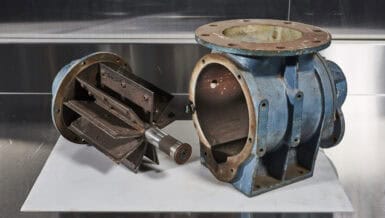
- Rotary valves
- Pneumatic conveying systems
Proper interface design is essential to ensure:
- Controlled discharge
- Consistent feeding
- Process stability
Future trends in silo design
The field of bulk solids handling is evolving rapidly.
Emerging developments:
- Smart sensors for real-time monitoring
- Digital twins for flow simulation
- Advanced material testing techniques
- AI-driven design optimisation
These technologies enable more accurate and reliable silo designs than ever before.
Conclusion
Silo design for dry solids is a complex engineering discipline that requires a deep understanding of material behaviour, geometry, and process integration.
The key to success lies in:
- Designing for mass flow whenever possible
- Properly sizing hopper angles and outlets
- Understanding material properties through testing
- Integrating safety and structural considerations
By applying these principles, engineers can avoid common pitfalls and ensure reliable, efficient, and safe bulk material storage systems.