


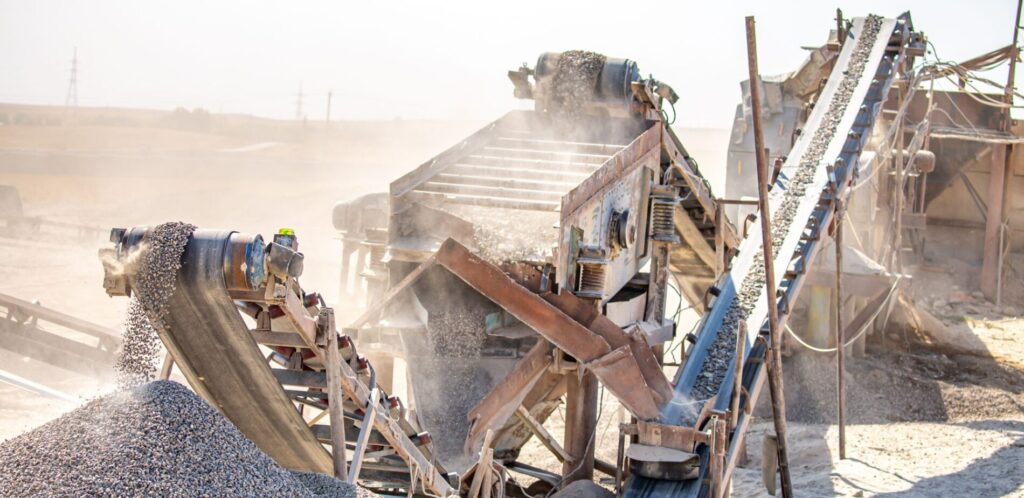
Handling bulk materials in silos, hoppers, conveyors, screw feeders, or pneumatic lines can easily create dust. Every drop, impact, or transfer causes fine particles to disperse: the dryer and more micronized the product, the higher the airborne dust load.
Because these particles are extremely light, they spread quickly and settle on nearby surfaces within minutes. The effects are often underestimated, showing their quiet aggressiveness to the worker’s health and to the equipment.
What dust is (and why its behavior changes everything)
Dust consists of solid particles suspended in air (or other gases), produced by mechanical actions, physical-chemical processes, or natural phenomena. Industrial dust typically has particle sizes below 500 μm and may originate from abrasion, breakage, condensation, or drying.
The size and mass of the particle determines whether dust remains airborne for long periods or deposits by gravity. It is this physical “fingerprint” that finally guides the choice of an effective extraction and filtration system.
Dust properties driving filter selection
In real plants, there is no “one-filter-fits-all” solution. Performance depends on dust characteristics and how they interact with filter media.
1) Particle size
Very fine dust may easily pass through the pores of filter or clog the media rapidly. In these cases, high-efficiency solutions such as vertical or horizontal cartridge filters are often preferred, as they are designed to capture micronized particulate while maintaining permeability.
Coarser dust behaves differently: it forms a surface cake that is easier to release during cleaning. In such applications, baghouse filter systems are commonly chosen, especially where heavier dust loads are expected, and cleanability is a priority.
2) Hygroscopicity (tendency to absorb moisture)
Powdered materials, such as flour, sugar, and some foodstuffs, are prone to picking up humidity, which causes clumping and crusts to form on the surface of the filter, leading to blinding and loss of efficiency. These effects are usually reduced by employing hydrophobic media or insulated designs that prevent condensation and moisture due to temperature drop. Wet filtration is usually most stable when dust is very humid, sticky, or the surroundings have high relative humidity. This technique uses water as a separation medium and does not have any buildup patterns that are typically associated with dry filters.
3) Abrasiveness
Over time, dust with hard particles like metals, cement, and minerals abrades the filter media. These applications call for rugged filtration systems and truly abrasion-resistant media. Baghouse filter solutions are often preferred in the most severe applications; when abrasiveness is coupled with very fine size, protected cartridge media can provide a better balance of durability and high-efficiency capture.
4) Conductivity and electrostatic charge build-up
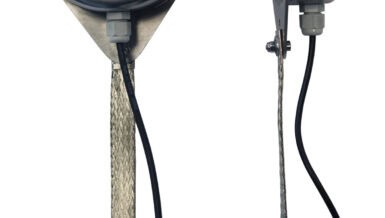
The metallic or plastic dust can accumulate electrostatic charges, posing an ignition hazard in potentially explosive atmospheres. Antistatic media, grounding, and certified ATEX/NFPA configurations become essential, with technology selection depends on process layout and dust transport method.
Tama Aernova’s on-site observations confirm a common pattern: dust rarely behaves in a single way, and cleaning strategies must reflect that complexity.
Filtration efficiency is dependent on cleaning, not only on media
A dust collector can be efficient if it ensures stable performance over a period of time. That is why the cleaning system is decisive: it must remove deposited dust efficiently without damaging the media and causing progressive pressure-drop increases.
The two most widely used approaches are:
- Pulse-jet cleaning with compressed air
Proven solution for both baghouse filter and cartridge systems. Short bursts of compressed air regenerate the media and control pressure drop, improving energy efficiency and extending service life. - Wet filtration systems
When dust is hygroscopic, sticky, or potentially explosive, water becomes the safest medium for separation. Wet scrubbers are used where sparks, volatile compounds, or “difficult” dusts make dry filtration ineffective or unsafe.
The right solution starts with dust analysis
Fine, adhesive, abrasive, or electrostatically charged: every dust has its own signature. For this reason, the best filtration setup will never be universal. It can only result from a combination of filter technology, media type, surface treatments, and regeneration method based on real dust behavior and process conditions.
Technical note
Tama Aernova develops industrial dust collection solutions for bulk solids handling, including cartridge systems (Kompac Air, Modul Air), baghouse filter units (Pulco Air), and wet scrubbers (Idromix). System selection is typically based on dust testing and process evaluation.