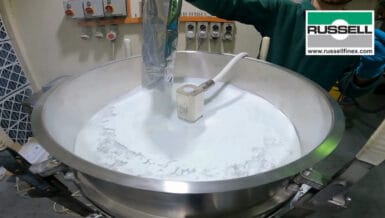



Traditional vibratory and ultrasonic sieving machines often struggle when processing fine calcium carbonate. Mesh blinding, declining efficiency, and unstable throughput are common during extended production runs. As a result, some processors are forced to compensate by increasing screen openings beyond the desired cut size in an effort to maintain acceptable flow rates.
This practice, often referred to as “cheating the hole,” allows material to pass through a larger mesh than the target specification, relying on process losses or downstream controls to approximate the desired particle size distribution. While this approach can temporarily improve throughput, it often results in reduced yields, wider size distributions, and inconsistent product quality.
Ultrasonic systems are frequently added to mitigate blinding, but they introduce additional complexity and maintenance requirements. Over time, ultrasonic performance can degrade, and operators may still be forced to oversize screens to keep production moving.
High-energy vertical sieving technology addresses these challenges directly.
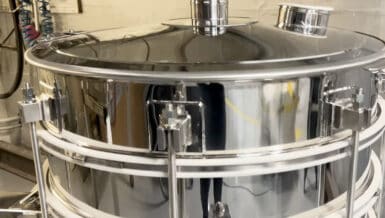
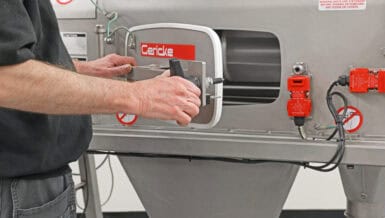
The Hi-Sifter high-energy sieving machine, developed by Elcan Industries, is designed to process difficult bulk powders, such as calcium carbonate, without ultrasonics or mechanical screen-cleaning systems. Its high-energy vertical motion, combined with a tensionless mesh, keeps the screen surface clear throughout operation.
This allows calcium carbonate to be screened at the actual target cut size. If the required separation is at a specific micron size, the material is sieved at that micron size, rather than compensating with oversized meshes. The result is a sharper cut, higher usable yield, and more consistent product quality over long production campaigns.
By maintaining an active screen surface, high-energy sieving also supports industrial throughput rates without relying on process workarounds or parallel screening stages.
As calcium carbonate producers continue to push toward finer separations and higher performance applications, the limitations of traditional screening methods are becoming increasingly apparent. High-energy vertical sieving offers a fundamentally different approach, delivering precise cut sizes, stable throughput, and repeatable results at an industrial scale.