


Introduction
Vibratory feeders are highly versatile machines designed to efficiently handle nearly all dry bulk solid materials, ranging from fine powders to granular, sticky, or large particle sizes such as metal stampings.
Electromagnetic feeders offer exceptional conveyance capabilities for the broadest range of materials. For example, plastic pellets, catalysts or cereal will typically feed well on all feeder models. However, materials that tend to cake, pack, break apart, or fluidize are generally handled on high-deflection models. In addition to their conveying function, feeders are widely employed in various industries to meter ingredients to mixers and blenders or feed materials for downstream process equipment, remove oversized or fine debris from final products through screening, and uniformly distribute salt, sugar, and a multitude of other ingredients.
With their multifaceted capabilities, vibratory feeders play a pivotal role in enhancing operational efficiency across numerous manufacturing and processing operations.
The design of each model vibratory feeder is unique, with varying tray displacement, frequency, and angle of deflection to move different materials at specific rates. Several factors influence the feeder design selection, including the characteristics of the material being processed, process flow rate, environmental conditions, the need to stop and start the feeder, equipment operating costs, and the likelihood of repairs.
The choice of the appropriate vibratory feeder type holds substantial importance as it can greatly influence operational performance and productivity. One of the primary differences in feeder models is the tray deflection or amplitude. The disparities between high deflection and standard deflection vibratory feeders lie mainly in their respective amplitudes of motion and operating frequency. This will have a significant impact on the capacity a feeder can achieve.
High Deflection Vibratory Feeders
High deflection vibratory feeders are universally recognized for their outstanding performance and versatility. These units harness advanced electromagnetic drives to generate high amplitudes and rapid motion, thereby significantly improving the ability to feed materials that were previously difficult to handle on vibratory feeders.
Materials from -50 mesh to -400 mesh tend to fluidize and flush on traditional electromagnetic feeders. After significant research and development efforts, Eriez introduced High Deflection (HD) Vibratory Feeders that provide deflection of up to 3/16-inch (4.8 mm) and lower frequency (30 cycles per minute) to handle finer materials more effectively.
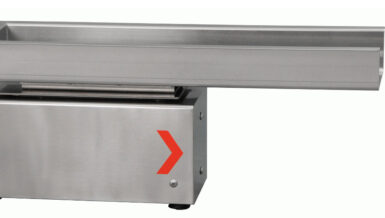
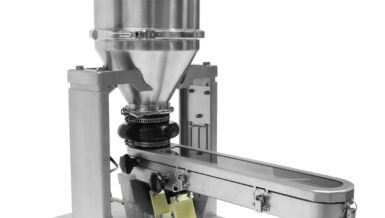
These compact feeders are often used for applications such as metering products from hoppers, transferring products from one conveyor to another, metering into bucket elevators, or feeding a scale.
High deflection vibratory feeders combine the higher deflection and lower frequency advantages of a mechanical feeder with the trouble–free service of an electromagnetic feeder. They effectively handle difficult-to-feed materials such as fine powders (talc or flour). The low-frequency operation does not fluidize the powder and the high deflection is not readily absorbed by the material. Airy or leafy products, such as lettuce or sawdust, also respond well. The high deflection goes beyond the vibration-absorbing nature of some materials and offers an effective feeding device where other feeder designs are unsuccessful.
Models in the Eriez HD feeder line offer travel speeds up to 80 feet per minute (24 meters/minute) and throughputs ranging from 150 to 700 cu feet/hour (4.25 to 20 cu meters/hour), making them ideal for packaging, chemical, and other tough applications.
Robust HD feeder models utilize AC electromagnetic drives that harness the power of permanent rare-earth magnets. This innovative design not only enhances performance but also yields considerable energy savings when compared to conventional DC-powered drives. By leveraging alternating magnetic forces, the requirement for a rectifier is eliminated, resulting in even lower power consumption.
Standard Deflection Vibratory Feeders
Standard deflection feeders in the Eriez product line include Models A and Model C units. These units are generally used to convey dry, free-flowing, pelletized, or granular and larger particle materials. Typical uses include regulating granular flow from a hopper to a second process before final packaging. These compact vibratory feeders accurately feed and control material flows at rates ranging from a few grams to nearly 45 tons per hour. These units are often applied where increased material loads are anticipated, such as below hoppers, or when heavy materials (nuts, bolts, sand) are being handled. Most dry bulk solid material can be effectively handled on an Eriez Model A or Model C Vibratory Feeder.
High-Speed Vibratory Feeders
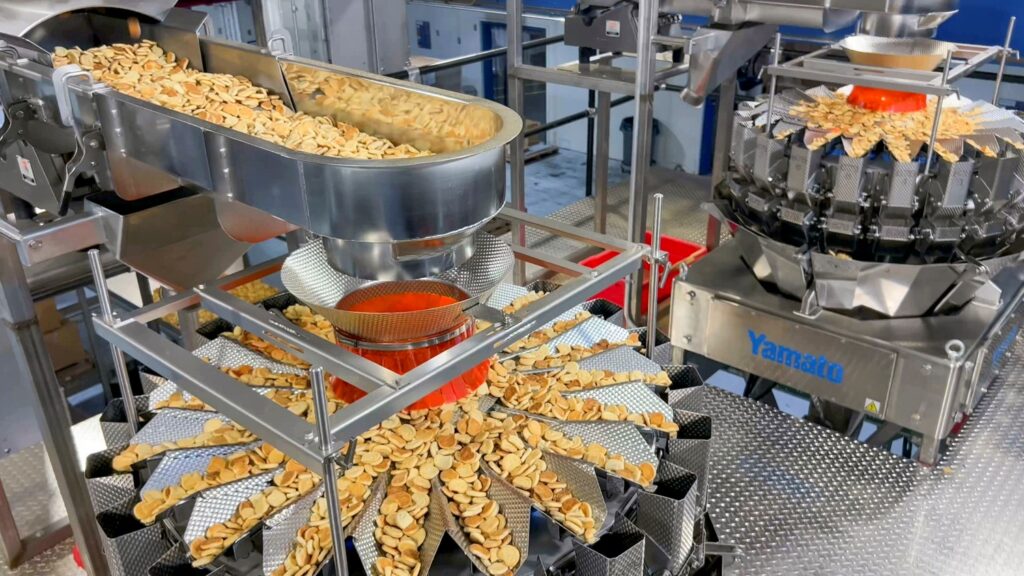
Eriez High Speed (HS) Vibratory Feeders are ideal for rapid on/off cycling and feature a faster speed rate. These units are designed for use with weigh scales and packaging machines. They deliver up to .090-inch (2.3 mm) tray displacement at 3000 or 3600 VPM and often achieve feed velocities of 50 feet per minute (15 meters per minute). HS feeders provide greater economy and efficiency in feeding, offering the fastest shutdown available due to their elastomer dampener. When a scale system signals the feeder to stop, the HS stops the flow in milliseconds.
Low amplitude, high-frequency feeders are an ideal choice for handling free-flowing materials with a bulk density, while high speed feeders are best matched with applications that require fast travel speeds, and frequent starts and stops.
Like high deflection units, Eriez A, C, and HS vibratory feeder models employ full-wave AC operation, making them more energy efficient than their DC counterparts. Similarly, they are low maintenance with no rotating parts or lubrication requirements.
Tray Designs
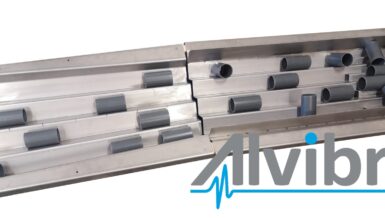
Whether high deflection or standard deflection feeders, the shape, length, and width of modern feeder trays are practically limitless. Customers can order standard design or custom feeder trays to satisfy their unique process requirements. Every configuration of flat, curved, v-channel, and tubular designs is available.
Trays are typically fabricated from mild steel for general-purpose processing or stainless steel for food, chemical, and pharmaceutical applications. Some trays are constructed of corrosion or heat-resistant alloys such as titanium or Hastelloy. Tray lining options include abrasion-resistant steel, stainless steel, urethane, rubber, and other coatings.
Optional tray covers or screen decks incorporate quick-release fasteners that enable these components to be removed without tools for easier cleaning.
Video Comparison
This video from Eriez shows a side-by-side comparison of the Eriez Model C and Model HS, both operating at 60 Hz, and Model HD operating at 30 Hz. Featured models simultaneously feed the same foods to provide a straightforward representation of how material characteristics affect performance. Viewers observe the contrast in control and speed when the feeders handle two dissimilar materials: popcorn and flour.