


In dry bulk solids handling, a diverter valve is rarely just a switching point. The way a conveying route is built affects the number of controlled components in the system, the space required for installation, the bends the product must pass through, the line resistance, and the number of service points maintenance teams inherit once the plant is running.
In pneumatic conveying systems handling powders and pellets, that design choice can affect both system complexity and product handling. A layout that works on paper can still introduce unnecessary complexity if it depends on several two-way diverters in series. Each additional diverter can bring another actuator, control output, connection, wear point, and area that may need access during inspection or service.
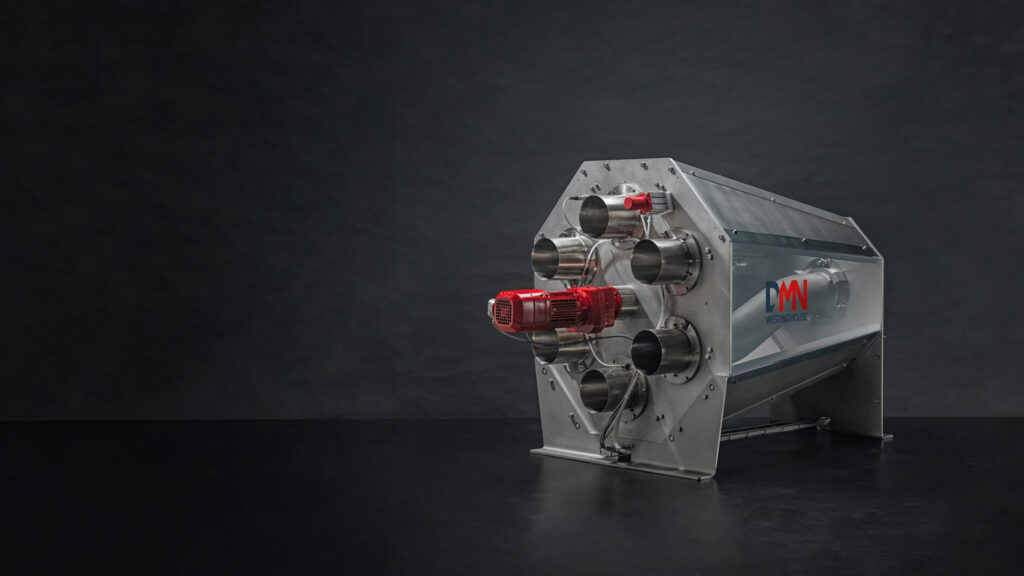
DMN-WESTINGHOUSE has launched the M-TDV multiport tube diverter valve to give processors a more compact way to address that design problem. The M-TDV is designed for pneumatic conveying systems in which product flow must be diverted from one line to multiple destinations or converged from multiple lines into a single line. Available in configurations from 4 to 14 ports, depending on size, it provides up to 14 routes through one compact diverter valve.
Fewer units in the routing layout
Port count has value, but the practical gain often comes from what can be removed from the wider system. By replacing a complex multi-diverter setup with a single compact unit, the M-TDV helps reduce control outputs, connections, and overall system complexity. For process engineers, this can simplify the routing architecture from the start. For maintenance teams, it means fewer service points competing for attention once the installation is operating.
This is especially relevant in plants where available space is limited or where multiple product streams need to be routed between silos, mixers, dosing points, process lines, packing areas, or storage systems. Combining routing functions into a single valve can help reduce system footprint without sacrificing flexibility.
The product path shapes performance
In pneumatic conveying, routing efficiency depends as much on the material path as on the number of valves in the system. In a series of two-way diverters, each diversion step introduces another change in direction. More bends can increase the risk of product degradation, pressure loss, and wear on surrounding system components. For fragile powders, pellets, granules, food ingredients, dairy powders, nutraceuticals, plastics, and other value-sensitive materials, the shape of the route can directly affect usable output.
The M-TDV limits the product path to only two smooth bends through a single valve. Its internal rotating swan neck guides the product between the inlet and selected outlet for diverting duty, or from the selected inlet to the outlet for converging duty. Exact alignment between the ports and internal swan neck creates a direct, controlled flow path through the selected route.
The swan neck radius supports a smoother internal flow path, helping minimise product degradation, pressure loss, and equipment wear.
Built for real installation loads
One practical challenge in multiport routing is maintaining accuracy under installed conditions. When plant piping is connected to all ports, the valve body has to remain stable under load.
The M-TDV has a highly rigid frame structure designed to support reliable alignment under full piping load. This helps the valve remain stable when connected to plant pipework and supports reliable switching between positions.
The switching design is supported by intelligent positioning. The valve takes the shortest route to the required port, while an encoder confirms position and an alignment cylinder ensures exact port lock. That combination supports controlled movement and consistent alignment during switching.
Service access without disturbing the line
Maintenance has also been treated as part of the product design rather than an afterthought. The M-TDV is designed for inspection and maintenance without removing the valve from the production line or removing factory piping.
Service work can be carried out from inside the valve, with access for seal replacement, cleaning, and inspection. Before an inspection can be performed, the swan neck must be removed, while seals can be replaced internally to help reduce disruption during routine service. Electrical and pneumatic components are mounted externally, making servicing easier and helping keep sensitive components away from product exposure.
Each valve also includes a QR code linking to the technical support page, which contains installation and maintenance manuals, as well as a seal replacement animation. It is a small addition but useful in real production environments, where fast access to accurate service information can reduce delays.
Transparent covers are available as an option, allowing visual inspection without disassembly. For plants where routine checks are frequent, that can make inspection more practical.
Hygienic and regulated applications
The M-TDV is available in hygienic execution for demanding production environments. USDA-accepted versions are available where required. Product contact materials are EC1935/2004-compliant, and the valve uses FDA-approved white EPDM inflatable seals. Stainless steel product contact surfaces are specified with a surface roughness of Ra 0.8 or less.
ATEX 2014/34/EU certification is available. The M-TDV is available in sizes from 40 to 150mm, with 4 to 14 port configurations depending on size. The conveying product temperature range is -20°C to +100°C, with pressure from -0.8 to 3 barg.
A simpler route to process continuity
The launch of the new M-TDV reflects a broader point in dry bulk handling. Routing decisions shape far more than the valve selection. They influence footprint, control architecture, product handling, maintenance access, and long-term reliability.
For processors handling powders and pellets, the M-TDV delivers up to 14 routes through one compact diverter valve, while helping reduce control outputs, connections, system complexity, and service points. It also limits the product path to only two smooth bends, supports alignment under real installation load, and improves service access in working plants.
About DMN-WESTINGHOUSE
DMN-WESTINGHOUSE designs and manufactures high-end rotary valves and diverter valves for dry bulk solids handling industries worldwide. Decades of engineering experience, application knowledge, and global support translate into proven valve technology, tailored solutions, and solid support focused on process continuity, product quality, reliability, and long-term performance. DMN-WESTINGHOUSE delivers future-proof value for demanding industrial and hygienic applications.
Technical data at a glance
The M-TDV is available in sizes from 40 to 150mm, with 4 to 14 port configurations depending on size. Standard execution uses aluminium and stainless steel, while dairy execution is all-stainless steel. Stainless steel contact surfaces have a surface roughness of Ra 0.8 or less. ATEX 2014/34/EU certification is available. The allowable conveying product temperature range is -20°C to +100°C, and the pressure range is -0.8 to 3 barg. The improved M-TDV is now available to order and fully replaces the previous model.