


Forklifts moving in and out of tight spaces, operators manually unstacking pallets, and uneven pallet supply all slow down production—especially near bulk bag fillers or packaging lines.
Automated pallet dispensers and stackers streamline this process, improving safety, throughput, and labor efficiency.
1. Why Manual Pallet Handling Creates Problems
Frequent Forklift Traffic
Forklifts moving through production areas increase the risk of collisions, near misses, and product damage.
Inconsistent Pallet Supply
Operators often wait for forklifts to deliver pallets, interrupting the filler’s cycle time.
Ergonomic Strain
Lifting, pulling, or unstacking pallets manually can result in back, shoulder, and hand injuries.
Inefficient Use of Labor
Operators spend valuable time retrieving and arranging pallets instead of monitoring equipment.
These issues compound as production rates increase. Automation eliminates much of the variability.
2. How Pallet Dispensers Work
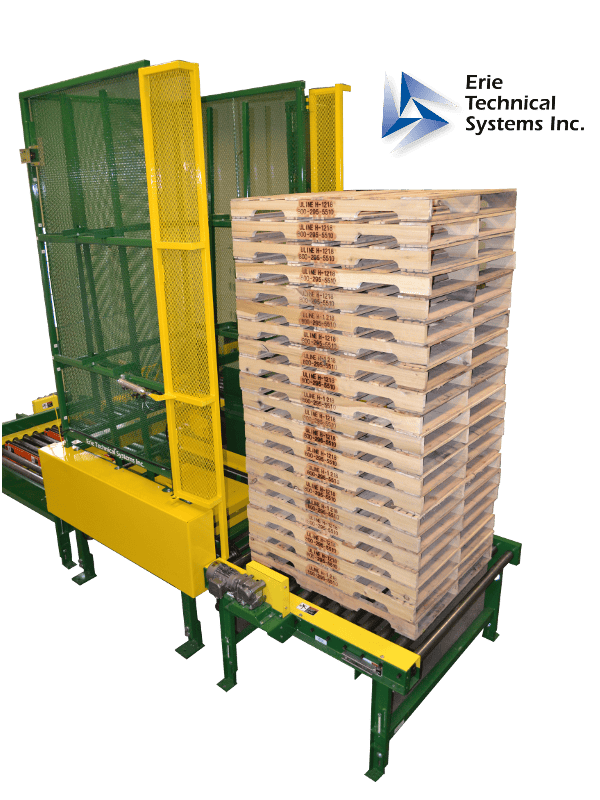
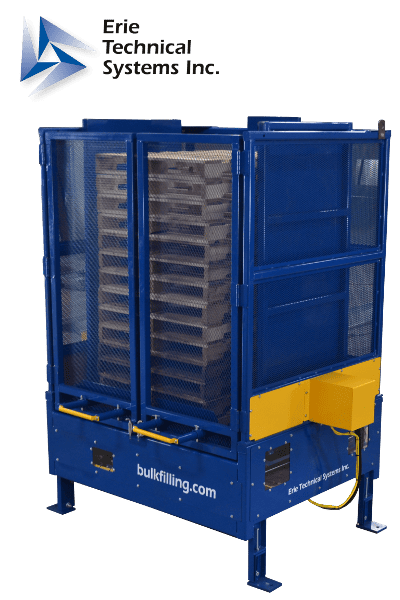
A pallet dispenser stores a stack of pallets and automatically releases one pallet at a time onto a conveyor or staging area. This ensures a constant supply of pallets without relying on forklifts.
Key Advantages
- Reliable Pallet Availability – The filler never waits—each cycle begins immediately with a pallet ready.
- Reduced Forklift Traffic – Forklifts bring one full stack instead of dozens of individual pallets.
- Improved Safety – Removes the need to manually unstack heavy pallets.
- Consistent Operation – Reduces variability in bagging cycle times.
Pallet dispensers are especially beneficial when paired with automatic bag removal or indexing conveyors.
3. How Pallet Stackers Improve Workflow
A pallet stacker automatically receives empty pallets and neatly stacks them in uniform, safe piles. This is especially useful at the end of a filling or packaging line.
Key Advantages
- Cleaner Work Areas – No more scattered or leaning stacks of empty pallets.
- Fewer Touchpoints – Operators aren’t manually stacking or straightening pallets.
- Safer Handling – Reduces risk of dropped pallets and ergonomic strain.
- Higher Storage Efficiency – Stacks are consistent and easier to move with forklifts.
Together, dispensers and stackers help stabilize production flow on both the inbound and outbound sides of material handling.
4. Automation’s Impact on Safety and Efficiency
Integrating pallet handling automation delivers measurable improvements:
Faster Cycle Times
A steady supply of pallets eliminates filler downtime and improves throughput.
Improved Operator Safety
Removing manual pallet handling reduces musculoskeletal injuries and forklift exposure.
Lower Labor Requirements
Operators can shift from pallet tasks to proactive system monitoring or quality checks.
Better Production Consistency
Automation removes variables that lead to slowdowns, backups, or operator fatigue.
5. When to Consider Pallet Handling Automation
Automation is a strong fit when:
- Fillers frequently wait for pallets
- Forklift congestion occurs near equipment
- Operators manually unstack pallets
- Production rates are increasing
- Safety incidents or ergonomic concerns are rising
- Storage space is tight and requires uniform stacks
If more than two of these apply, automation can deliver rapid ROI.
Automating pallet handling is one of the simplest ways to improve safety, reduce downtime, and create a more predictable production environment—especially in facilities filling bulk bags, drums, or pallets of packaged product.