


Accurate determination of material moisture is one of the fundamental pillars of modern quality assurance across numerous industries. Water content in raw materials, intermediate products, or waste materials significantly influences physical material properties, subsequent processability, storage stability, and ultimately the commercial value of the goods. An undetected moisture content that is either too high or too low can lead to severe production defects, quality losses, increased energy consumption, or logistical issues such as clumping. For this reason, contemporary manufacturing processes demand fast, precise, and reproducible measurement methods directly in the laboratory or close to the production line. The spectrum of materials to be analyzed is extremely diverse, presenting specific challenges for measurement technology depending on the industry.
In the construction industry, the moisture content of raw materials directly determines the stability, safety, and workability of end products like concrete or cement. Inaccurate moisture determination of aggregates, such as sand or gravel, inevitably leads to errors in the mixing ratio. Since mineral construction materials are extremely resistant to thermal stress, their moisture can be efficiently driven out at very high temperatures. This yields rapid measurement results and prevents delays in the production flow. The situation is similarly critical in the chemical industry, where moisture significantly dictates the flow properties of powders, granulates, and pastes. Powders with excessive moisture tend to form bridges in silos or stick during tableting, while in viscous systems and pastes, the water content controls the viscosity and chemical stability. Here, high-precision weighing technology combined with exact temperature control is absolutely essential to separate volatile components from pure moisture. A completely different yet equally economically relevant area of application is found in environmental technology at municipal and industrial wastewater treatment plants for the moisture determination of sewage sludge. The disposal and landfill costs of sewage sludge are calculated based on its weight. The more efficiently the dewatering process is monitored—which is achieved through continuous determination of the dry matter content—the more massively transport and incineration costs can be reduced. Since this involves an organic-inorganic mixed product with a viscous to pasty consistency, driving out the moisture thermally is a highly demanding task.
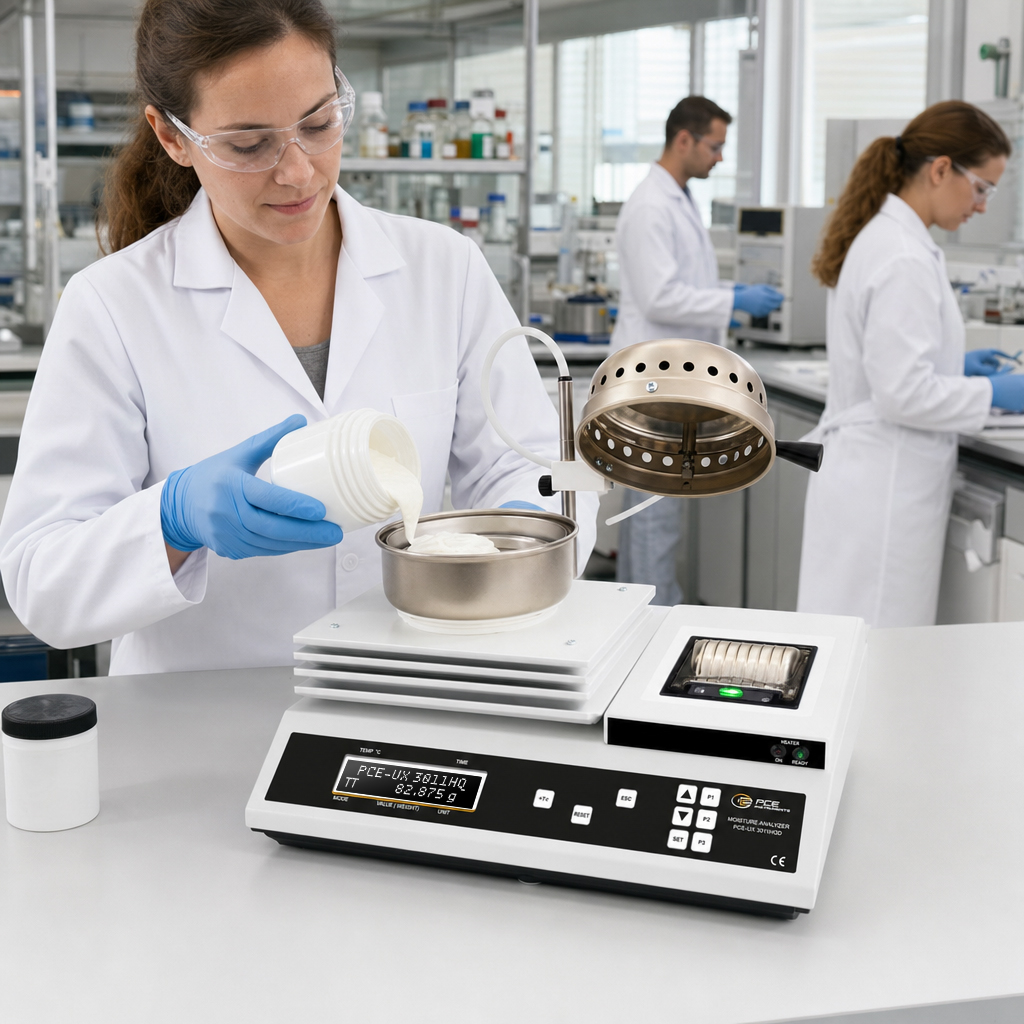
The most reliable standard method for all these industries is thermogravimetry, often referred to in practice as the loss-on-drying method. This involves heating the sample, evaporating the contained water, and continuously recording the resulting weight loss. Because classic drying ovens in everyday laboratory routines often take hours to deliver a result, modern system solutions combine a high-precision weighing unit with a powerful heating element in a compact device to shorten the measurement time to just a few minutes. For temperature-resistant materials that require rapid and uncompromisingly precise moisture analysis, the market offers specialized high-end measuring instruments.
A technologically leading and field-proven solution for these demanding tasks is the instrument series from PCE Instruments, which is available in two application-specific model variants: the PCE-UX 3011HQ and the PCE-UX 3011HQD. While both models are identical in design and deliver the same high measurement performance, the PCE-UX 3011HQD variant distinguishes itself with an integrated printer. This allows users to document measurement results legally and directly on-site on paper, without the need for detour via an external system. While standard moisture analyzers usually reach their performance limits at 160 °C or a maximum of 200 °C, both versions of this series allow drying temperatures of up to 600 °C. This drastically shortens the measurement time for extremely temperature-resistant samples, as even deeply bound capillary water is driven out in a flash. Paired with a generous weighing range of up to 200 g, even inhomogeneous samples such as coarse gravel or pasty sewage sludge can be weighed in sufficient quantities to achieve a representative average value. Thanks to the high measurement resolution of 0.001 g, the determination remains absolutely precise even with low moisture contents. Furthermore, the system supports seamless traceability within quality management through GLP-compliant data output via RS232 or USB interfaces.
In summary, material moisture measurement is an indispensable tool for increasing efficiency and minimizing costs. Through the flexible deployment of the PCE-UX 3011HQ or the printer variant PCE-UX 3011HQD, measurement cycles in quality assurance can be massively shortened, guaranteeing precise, fast, and reproducible analyses from the gravel pit to the chemical reactor and all the way to sludge dewatering.