


For flour mills and large-scale food processing plants, the sieving and post-sieving transfer stage is where production bottlenecks are most commonly created. Mesh blinding slows throughput. Open handling systems create dust and contamination risk. Manual transfer between the sieving machine and the packaging or storage stage introduces labour dependency, inconsistent flow, and hygiene exposure at the most critical point in the line.
As production capacities increase, these problems do not stay manageable. They compound.
Why Flour Is One of the Most Demanding Materials to Sieve at Scale
Wheat flour has a low bulk density — typically around 550 to 580 kg/m³ — which means it does not move reliably through a fine mesh by gravity and vibration alone. Fine particles float, generate dust, and accumulate on screen surfaces rather than passing through cleanly. As the mesh progressively blinds during a production run, effective screening area reduces, throughput drops, and particle size consistency in the output begins to vary.
For flour mills supplying bakeries, food manufacturers, and retail packers, this variability is not acceptable. Buyers specify exact particle size requirements, and any deviation — whether through oversized particles, lumps, or foreign matter reaching the finished bag — creates quality complaints, returns, and supply relationship damage.
Conventional vibratory screens can handle moderate flour volumes adequately. But at industrial-scale throughput — where a single line must process multiple tonnes per hour continuously across shifts — the limitations of vibration-based sieving become a recurring operational cost rather than an occasional inconvenience.
What Centrifugal Sifting Changes for High-Capacity Flour Lines
The fundamental problem with vibration-based sieving for fine, low bulk density flour is that the screening mechanism relies on gravity and oscillation to move material across a flat screen surface. At high throughput, this approach struggles to keep pace — particularly when the material is as light and cohesive as fine wheat flour.
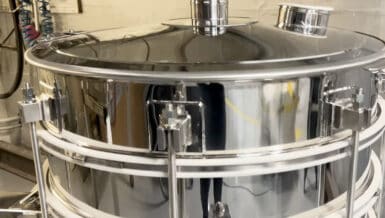
Centrifugal sifting works on a different principle entirely. Material is fed into an enclosed cylindrical chamber where rotating beaters propel the flour outward against the mesh screen with controlled centrifugal force. This active, forced-feed action drives material through the mesh rather than waiting for it to pass through under gravity. The result is a screening mechanism that is inherently better matched to the behaviour of fine, low bulk density powders at high production volumes.
For flour processing specifically, this shift in mechanism delivers three operational changes that production managers notice immediately.
Mesh blinding is significantly reduced. Because the rotating beater action continuously moves material against and through the mesh, the progressive particle accumulation that causes blinding in conventional screens does not occur in the same way. Throughput holds steady across the full production run without manual intervention.
Soft lumps and agglomerates formed during storage or handling are broken and separated in the same pass. There is no need for a separate de-lumping step upstream of the sifter — the centrifugal action handles it within the screening cycle itself.
And the fully enclosed, dust-tight construction eliminates airborne flour dust during operation. For food processing environments where hygiene standards and workplace safety regulations must both be met, enclosed operation is not optional — it is a baseline requirement that open vibratory systems cannot reliably deliver at high throughput.
The Part Most Plants Overlook — What Happens After the Sifter
Upgrading the sieving machine solves one part of the problem. But in many flour processing facilities, the stage immediately after the sifter — the transfer of screened flour to storage or packing — remains manual, open, and inconsistent.
Operators carrying, tipping, or scooping screened flour between the sifter outlet and the packing machine introduce variable feed rates that cause downstream equipment to surge and starve. Weight inaccuracies, packing machine downtime, and product waste follow. And every manual touchpoint between sieving and packaging is a hygiene risk that food safety auditors and certification bodies will scrutinise.
This is where an integrated inclined screw conveyor completes the system.
Positioned directly at the screened flour outlet of the sifter, the inclined screw conveyor transfers clean flour upward in a continuous, enclosed, automated flow — directly to the storage silo or packing machine. The transfer happens entirely within a sealed system. No open discharge points, no manual handling, no exposure of screened flour to the processing environment between sieving and packaging.
The conveyor delivers a steady, metered, consistent material flow that holds regardless of operator availability or shift changes — matching the sifter’s output rate and feeding the downstream packing machine with the uniformity it needs to run accurately and efficiently.
One System, One Throughput, One Quality Standard
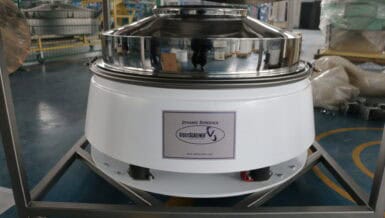
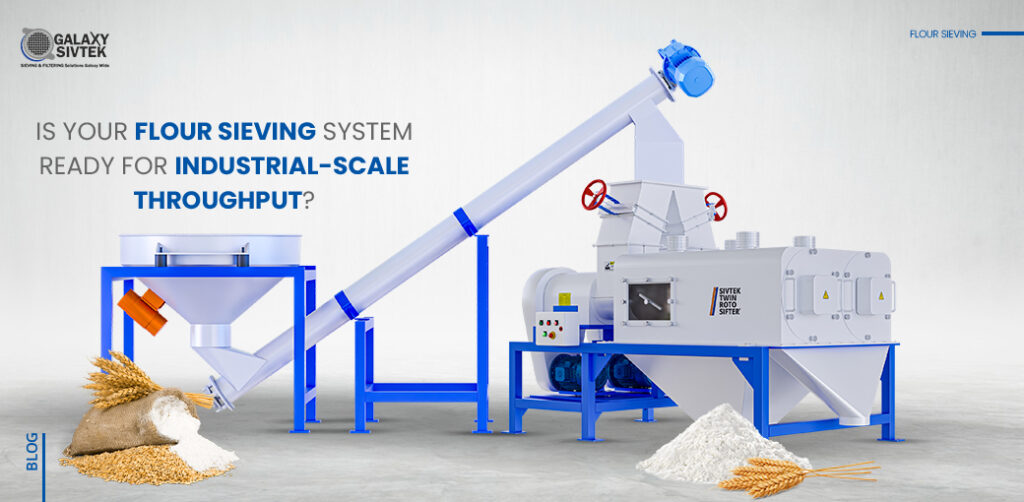
The SIVTEK Twin Roto Sifter 1350 paired with an integrated inclined screw conveyor is Galaxy Sivtek’s answer to the complete industrial flour sieving and handling challenge.
The Twin Roto Sifter 1350 is a twin-chamber centrifugal sifter designed specifically for fine, low bulk density powder applications at industrial scale — capable of processing up to 40 tonnes per hour of flour in a fully enclosed, food-grade stainless steel construction that meets FDA and cGMP standards.
The integrated inclined screw conveyor handles the post-sieving transfer — moving screened flour from the sifter outlet upward to the storage silo or packing machine in a continuous, enclosed, contamination-free flow that eliminates the manual handling and inconsistent transfer that undermines production efficiency downstream.
Together, they form a single engineered system with one throughput rating, one dust containment regime, and one consistent quality output across the full process flow — Feed Hopper → Twin Roto Sifter 1350 → Inclined Screw Conveyor → Storage Silo or Packing Machine.
For facilities that have outgrown their existing sieving setup, or that are building new high-capacity lines and need a proven integrated solution, this system brings industrial-scale flour processing capacity into a compact, food-grade, hygienically designed configuration that meets the throughput and compliance demands of modern flour processing operations.
The Bigger Picture: Why Integration Matters More Than Individual Machines
The shift happening in industrial flour sieving systems is not just about replacing one machine with a better one. It is about recognising that sieving and post-sieving material handling are two parts of the same production challenge — and that solving one without the other leaves the line operating below its potential.
Flour mills and food processing plants that have made this shift report the same outcomes: fewer production stoppages, more consistent throughput, lower labour dependency at the sieving and transfer stage, and a cleaner, more auditable production environment from sifter to bag.
Galaxy Sivtek provides advanced sieving, screening and filtration solutions for flour mills, food processors, and bulk powder handling facilities across global markets.
To discuss your flour processing requirements and find the right integrated sieving and handling configuration for your production line, connect with the Galaxy Sivtek application team.