


Whether processing pigments, additives, food ingredients, pharmaceuticals, cosmetics, or specialty chemicals, poor powder incorporation leads to floating powders, fisheyes, agglomeration, longer batch times, and inconsistent product quality. Once agglomerates form, they require additional time and energy to break apart, increasing both processing costs and operator involvement.
Many inline rotor-stator systems do an excellent job of dispersing materials after they enter the process. The challenge often begins before that. Dry powders bridge, float on the liquid surface, or trap air as they enter the batch, making uniform wet-out difficult.
This is where equipment design becomes important.
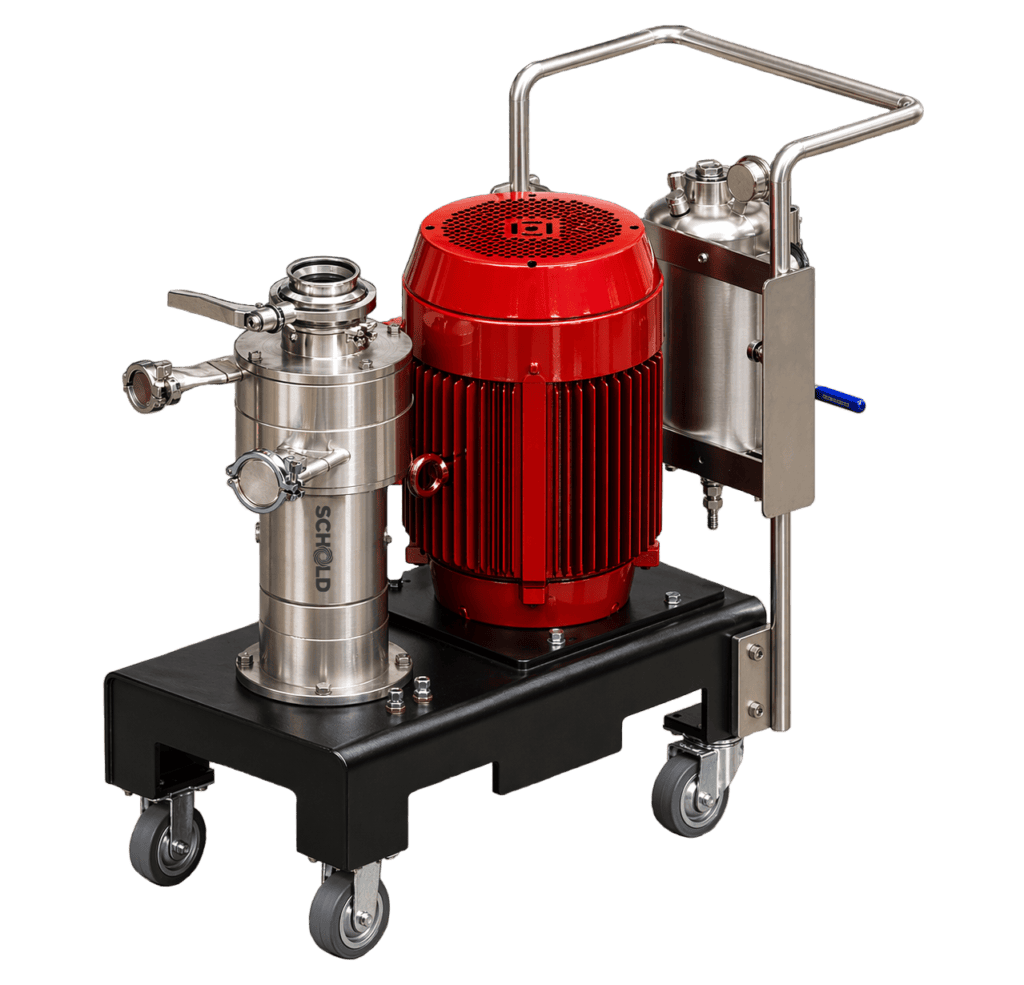
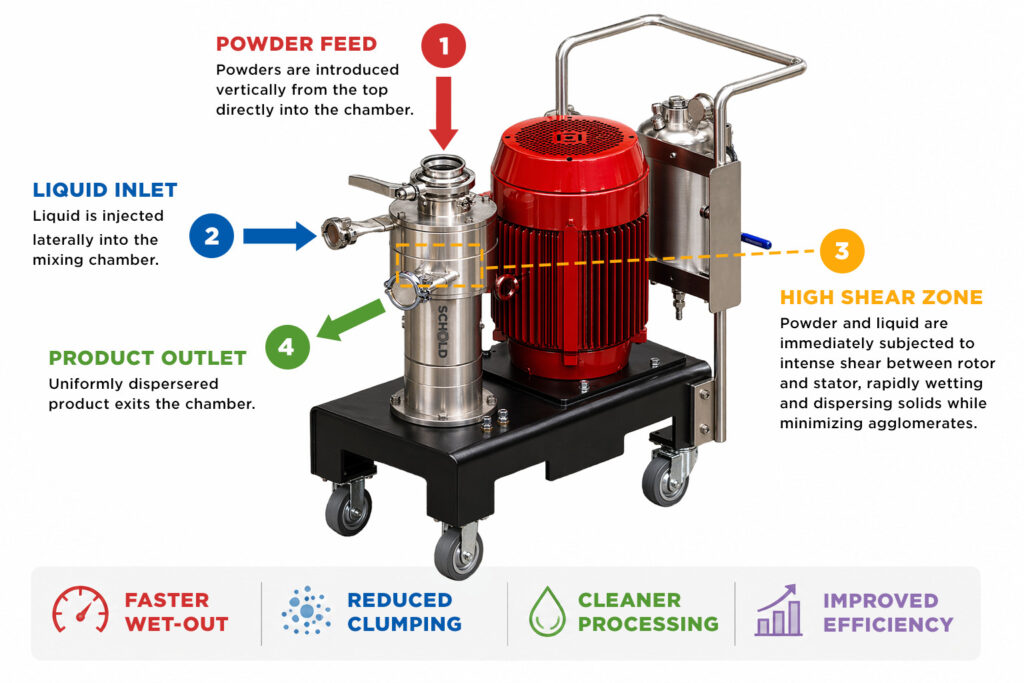
Recognizing this challenge, Schold recently introduced the ILD-P Powder Induction System, a dedicated inline solution designed specifically for powder incorporation. Unlike conventional powder addition methods, the ILD-P features a vertical powder feed configuration that introduces dry ingredients directly into a high shear rotor-stator mixing chamber while liquid enters laterally. Powders are immediately wetted and dispersed as they enter the shear zone, reducing the opportunity for clumping and improving overall incorporation efficiency.
The benefits extend beyond faster dispersion. Improved powder induction reduces processing time, improves batch consistency, minimizes dust during material handling, and reduces the need for operator intervention.
The ILD-P expands Schold’s growing inline dispersion product family. For general inline dispersing, emulsification, and recirculation processing, the company’s ILD Inline Disperser continues to serve a wide range of production applications. Schold has also introduced the Lab ILD Inline Disperser, allowing manufacturers to evaluate formulations, validate processes, and perform pilot-scale testing using the same rotor-stator technology found in production systems.
As manufacturers continue developing more demanding formulations, powder incorporation is becoming an increasingly important part of process design. Addressing powder induction at the beginning of the process improves efficiency throughout the rest of the operation, resulting in shorter processing times, more consistent products, and a more repeatable manufacturing process.
For processors looking to improve powder incorporation, selecting equipment designed specifically for that task can make a measurable difference long before the batch is complete.
Learn More
Learn more about powder induction challenges and Schold’s inline processing solutions:
- Read: Why Powder Induction Is One of the Biggest Challenges in High Shear Mixing
- Explore: Schold Mixing, Milling & Dispersion Equipment
- Discuss Your Application: Contact the Schold team