


However, bulk solids can behave unpredictably. Variations in flowability, bulk density, particle size, and moisture sensitivity may lead to inconsistent feed, bridging, segregation or unnecessary downtime. Selecting equipment based on material behaviour rather than capacity alone is therefore key to achieving dependable long-term performance.
With more than 30 years of experience in powder metering and conveying, Trantec Solids Handling outlines common bulk solids dosing challenges faced by treatment plants and how to address them. Through its dedicated material testing facility, Trantec helps customers understand material behaviour and optimise equipment solutions for their individual process requirements.
Inaccurate or Inconsistent Dosing
Poor feed control can result in over- or underdosing, reducing treatment performance and increasing chemical consumption. Accurate dosing is therefore particularly important when handling materials such as lime or PAC, where consistent feed rates directly affect treatment results.
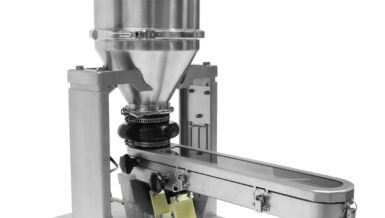
Screw feeders are widely used where controlled and repeatable discharge is required. By regulating flow from a hopper, they provide a stable feed rate and integrate effectively with weighing systems, particularly at lower throughputs or where higher accuracy is needed.
Bridging, Ratholing, and Poor Hopper Flow
Cohesive or aerated powders can compact within storage hoppers, leading to flow problems such as bridging and rat-holing, which prevent consistent discharge. These issues are common causes of erratic feed and often require operator intervention.
Correct hopper geometry is essential, but an agitator device also plays an important role in maintaining reliable material flow. In screw feeder applications, the agitator is typically positioned within the feeder body to promote even filling into the auger. In conveyor applications, it may be installed at the inlet to encourage consistent feed into the conveying spiral. Additional design options, such as twin screw feeders, mass flow configurations, and variable pitch augers, can also be used to improve discharge performance, depending on the product being handled.
Restricted Space and Difficult Plant Layouts
Many treatment facilities operate within existing buildings where available space is limited, and layouts are difficult to modify. Installing fixed-route conveying systems is not always practical.
Flexible screw conveyors can provide an effective solution where routing around obstacles is required. Their compact design allows material to be transferred from sack tip stations or bulk bag dischargers into intermediate hoppers, while minimising the installation footprint.
Abrasive, Wet, or Difficult Materials
Some treatment materials create additional handling challenges. Lime can be abrasive, sludge-based products may be fibrous or sticky, and certain powders may degrade if handled aggressively.
Rigid screw conveyors are often selected where a more robust transfer solution is required. Ribbon screws can reduce build-up with cohesive products, while shaftless screw designs are suited to wet or fibrous materials. Wear-resistant components can also improve service life when handling abrasive powders.
Dust, Segregation, and Product Loss
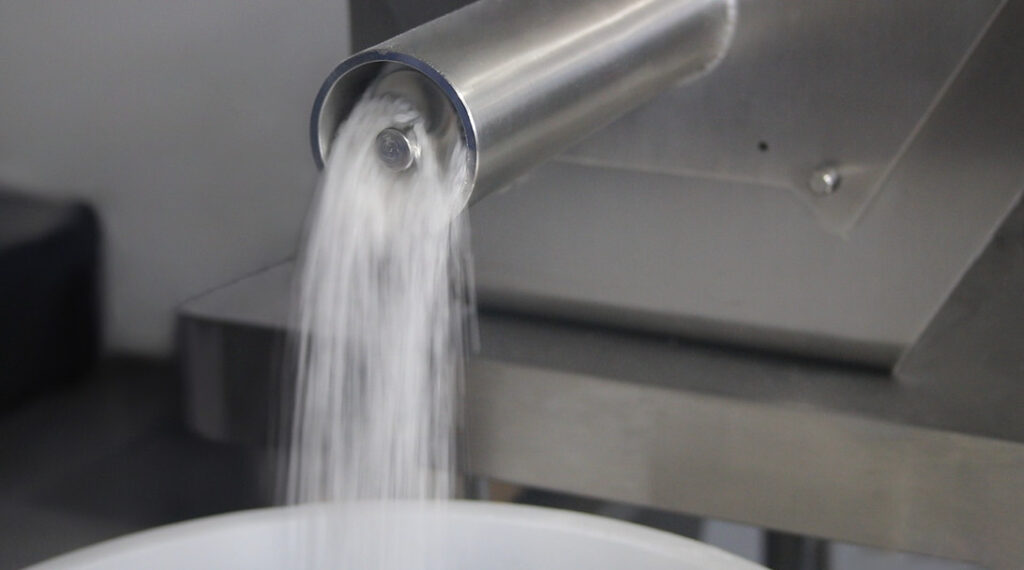
Lightweight powders such as PAC can generate dust during transfer, while blended materials may separate into their individual components if handled incorrectly. Both issues can affect process consistency, housekeeping standards, and material usage.
Enclosed conveyor systems, including flexible and rigid screw conveyors, can help improve containment. Selecting the correct screw or spiral design can also reduce product disturbance during transfer and minimise the risk of material separation. In many cases, material testing is the most effective way to confirm the suitability of the equipment design before installation.
System Design Matters as Much as Equipment Selection
In many successful installations, multiple technologies are combined. Material may be transferred using a flexible or rigid screw conveyor into a hopper, where a screw feeder then meters it accurately into the treatment process.
Reliable performance is rarely achieved through equipment selection alone. Understanding how the material behaves and designing the hopper, inlet, auger, and control system accordingly is often the difference between a system that performs consistently and one that creates ongoing maintenance issues.