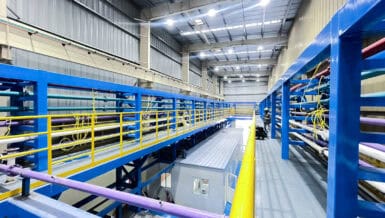



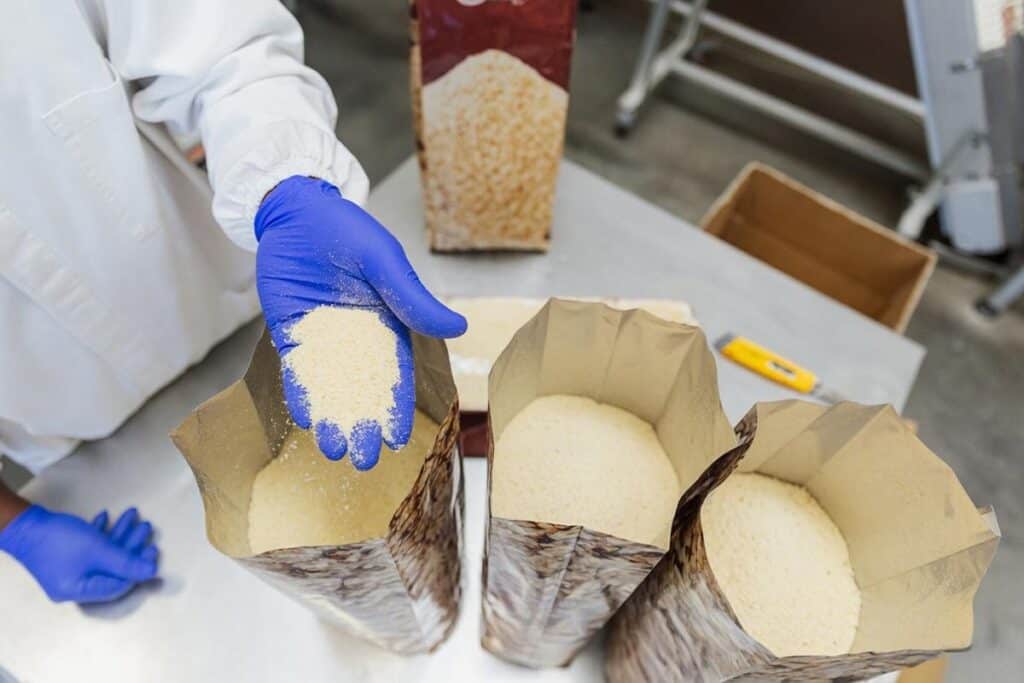
Food Standards Australia and New Zealand (FSANZ) coordinates every food recall in the country and has a formal category for this: accidental cross-contamination. It’s one of the six root causes of undeclared allergen recalls and occurs when a raw ingredient is contaminated during the production process. Between 2021 and 2025, undeclared allergens drove 197 recalls in Australia. Accidental cross-contamination was one of the main causes identified, alongside supplier verification issues.
For powder handling, that’s a pointed and costly statistic. Powder production runs multiple formulations across shared lines more often than most food categories, and fine powder can easily migrate between batches when a conveyor, hopper, or blender isn’t fully cleaned down. A single allergen cross-contact event can pull product off shelves, trigger a recall, and rewrite your insurance premium. The conveyor is one of the most overlooked risk surfaces, at least until an auditor or a recall investigation asks for an inside look.
The regulatory backdrop in 2026
Food safety schemes aren’t standing still. In the US, the preventive controls requirements of the Food Safety Modernization Act (FSMA) continue to push food manufacturers toward documented, verifiable control points rather than end-of-line testing. Brand Reputation through Compliance Global Standards (BRCGS) ninth edition and Food Safety System Certification (FSSC) 22000 both put growing weight on allergen management as a standalone discipline, not a subset of general hygiene. Safe Quality Food (SQF) auditors are asking more pointed questions about equipment design, not just cleaning schedules.
Allergen disclosure rules also keep evolving. Australia’s Plain English Allergen Labelling requirements only came into full force in February 2026, after a multi-year transition period. As labelling standards tighten, there’s less room for a cross-contact event to go unnoticed or unaddressed — a single undeclared allergen is enough to put a product out of compliance. Similar tightening is under way in other markets, and the trend is consistent: less tolerance for ambiguity, more expectation a manufacturer can demonstrate control rather than simply assert it.
For technical buyers, it changes what “compliant” means in practice. A decade ago, a validated cleaning schedule and an accurate label were largely sufficient. Increasingly, auditors want to see the food processing equipment was chosen with allergen risk in mind, not retrofitted around a design originally specified for throughput alone.
None of these schemes name a conveyor type. What they all ask, in different words, is the same thing: can you show that this equipment doesn’t let one product carry into the next? That question increasingly gets asked at the design and validation stage, not just during the physical walk-through.
EHEDG and hygienic design fundamentals
The European Hygienic Engineering & Design Group (EHEDG) guidelines are the reference point most auditors and equipment specifiers use, even outside Europe. The principles are consistent:
- Smooth, corrosion-resistant surface finishes, with no pitting or rough welds
- Drainable geometry, so nothing pools
- Dead-leg elimination, with no pockets or dead-end sections where product settles and stagnates
- Joint integrity, since a degraded seal or a poorly fitted gasket is a hiding place for residue, no matter how good the rest of the design is.
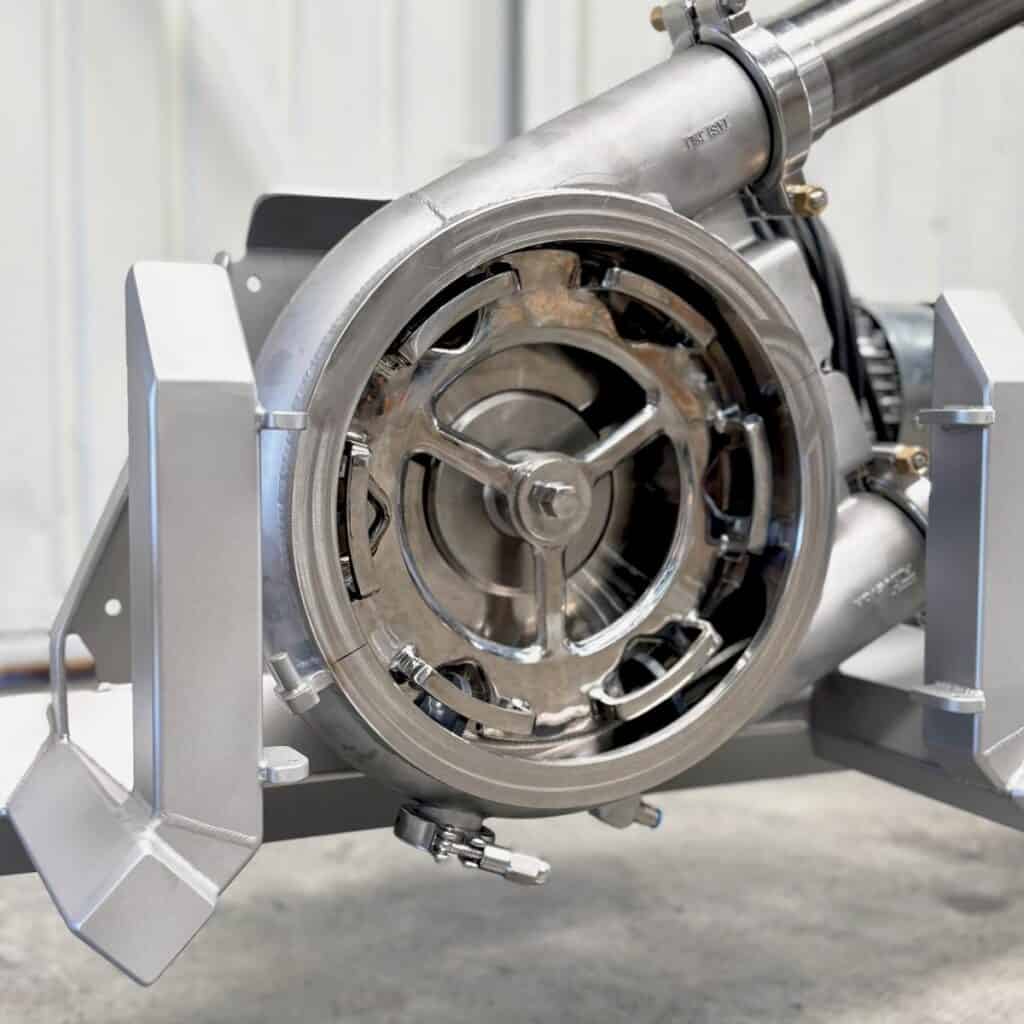
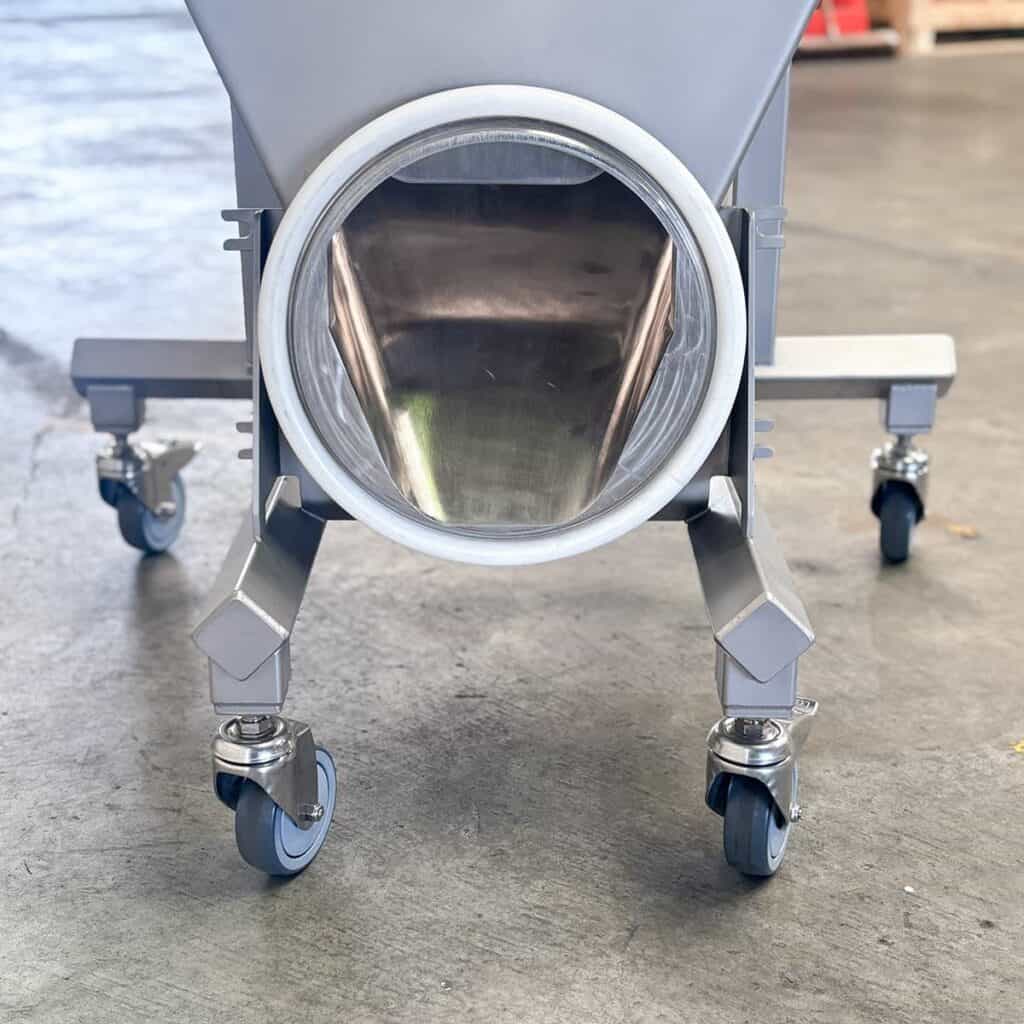
It’s worth being precise about the hygiene tier you need. Standards like EHEDG, 3-A Sanitary Standards, and FDA and EX requirements set the benchmark for food, beverage and nutraceutical hygiene, including polished welds, tri-clamp fittings with hygienic sealing rings, defined surface-finish tolerances, and materials suited to repeated cleaning. Equipment purpose-built for sterile pharmaceutical processing is a different, considerably more expensive specification again, and most food and nutraceutical production doesn’t need it. Overspecifying adds cost and complexity without a corresponding safety benefit; underspecifying leaves you exposed at audit time. The right answer sits in the middle for most food manufacturers, and your OEM can advise you before you commit to a design.
Where conveyors fail an audit
In our experience, most conveyor-related audit findings result in a handful of repeat offenders.
- Horizontal product trapping on surfaces where material sits and sheds over time rather than moving straight through
- Inaccessible internals that need tools or extra downtime for inspection, meaning they get inspected less often than they should
- Gasket condition, including seals that have degraded or been replaced with the wrong material during routine maintenance
- Residue at transitions: the elbows, discharge points, and direction changes where the product loses momentum and drops out of suspension.
None of these are unusual problems. They’re also not always visible from outside the conveyor or process line, which is precisely why they arise at audit time rather than on the production floor. A conveyor can run mechanically sound for years while quietly failing every one of these tests. None of them affects throughput or output quality until built-up residue cross-contaminates a batch. That’s the uncomfortable part for technical buyers: a conveyor that never causes a production problem isn’t necessarily a hygienically sound conveyor. It simply hasn’t failed yet.
Wet, dry, and clean-in-place (CIP)
The right cleaning regime depends on the product and its moisture tolerance. Wet-cleaning and clean-in-place (CIP) equipment suits products that tolerate water exposure and situations where microbial risk, not allergen risk alone, is the main concern. Dry-cleaning suits moisture-sensitive powders, where introducing water can create contamination or product-quality problems.
Many facilities run mixed cleaning regimes across different process lines or products. This means the conveyor’s cleaning method must be decided at the specification stage. This includes whether the design supports rapid CIP on the core of the machine and easy COP (clean out-of-place) on ancillary parts, which is a common combination for allergen-sensitive food and nutraceutical lines. A conveyor built around washdown assumptions and then used only for dry runs, and vice versa, creates compromised cleaning outcomes for the life of the equipment.
Allergen segregation strategies
Dedicated process lines remove changeover risk but aren’t always commercially realistic for every facility or every SKU. Where lines are shared, compliance is improved through:
- Validated changeover procedures
- Sequencing (e.g., running allergen-free products ahead of allergen-containing ones)
- Easy-cleaning equipment that can be quickly opened, cleaned, and verified within a practical changeover window.
The conveyor’s design sits under all three of these strategies. Dedicated lines only work if the conveyor genuinely can’t cross-contaminate with anything else onsite. Validated changeover depends on the conveyor being physically capable of full, verifiable clean-down within the time a changeover allows. Sequencing only reduces risk if the equipment between allergen and non-allergen runs is cleared before the next batch starts. If a conveyor can’t be opened, cleaned, and reverified quickly, it becomes the bottleneck tempting operators to cut corners when production runs are tight.
Aero-mechanical conveying in hygienic environments
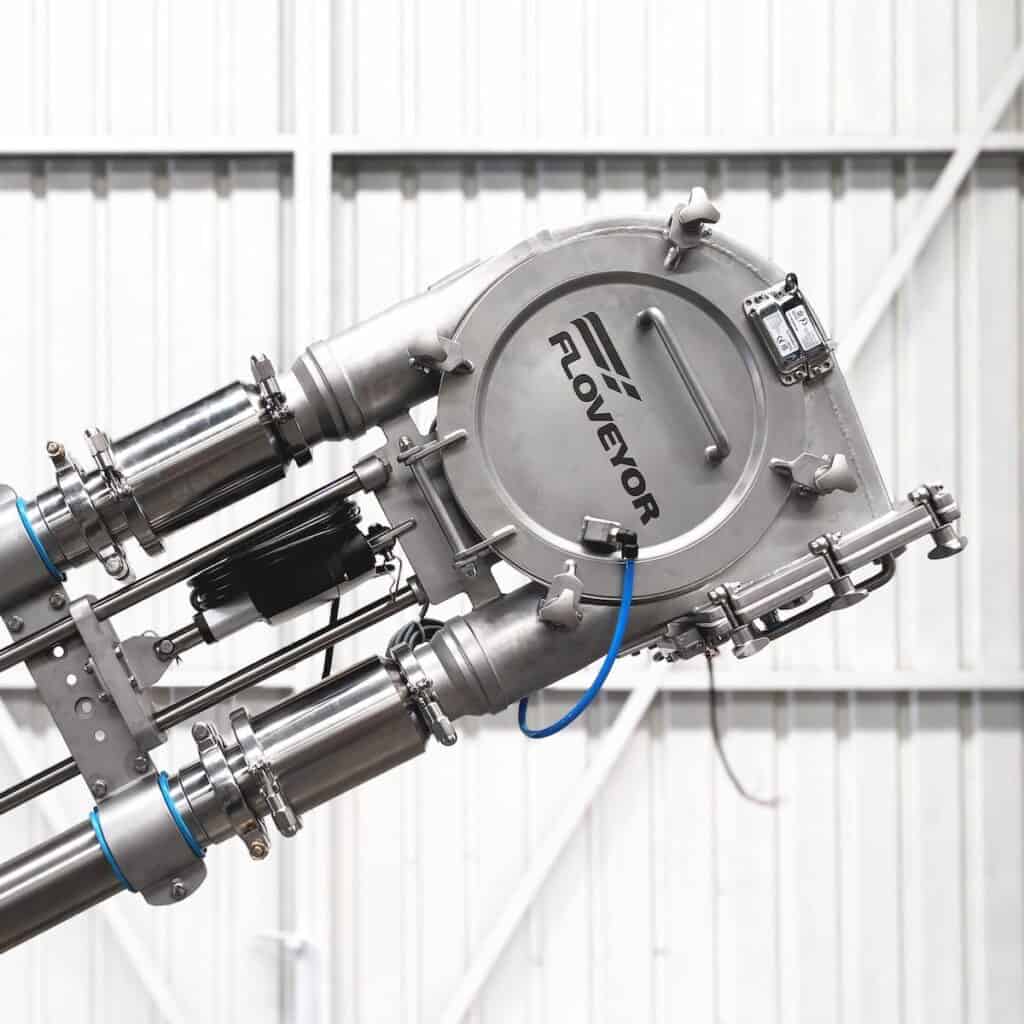
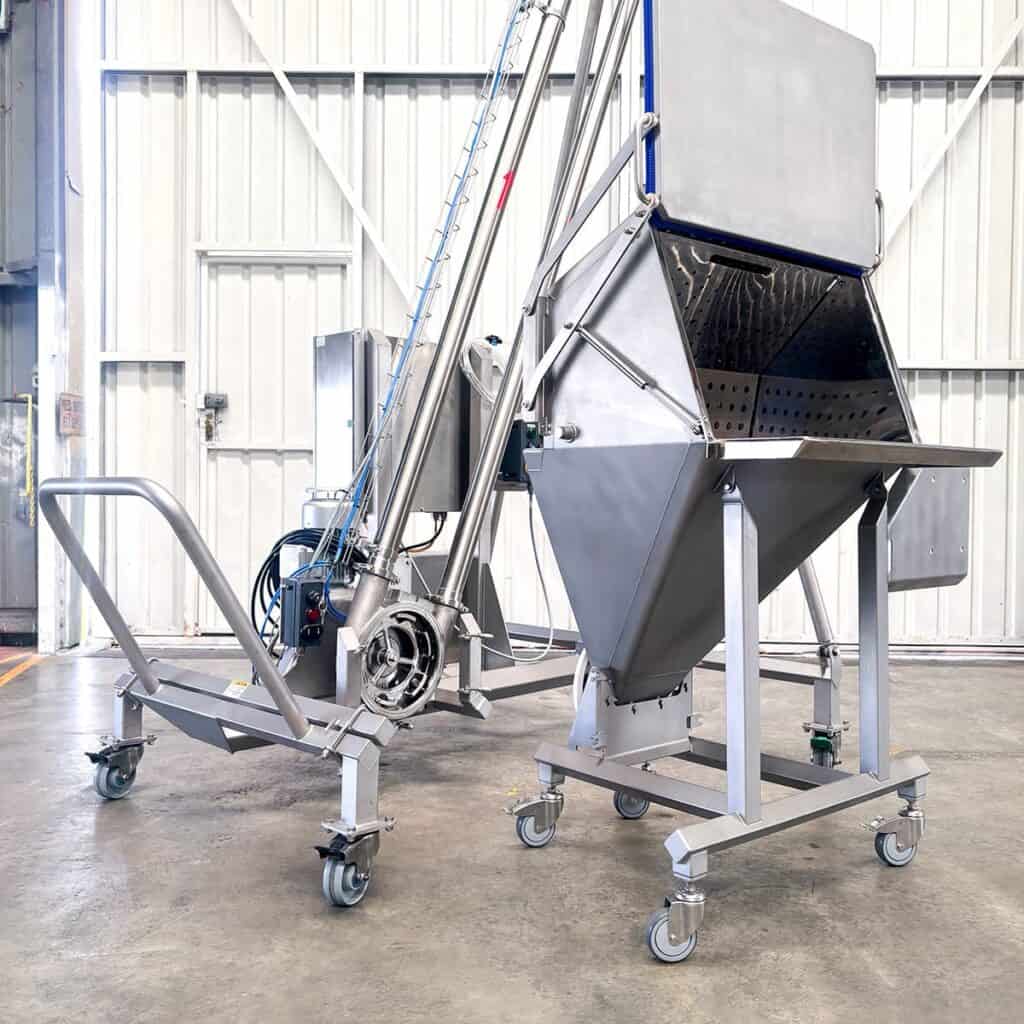
Floveyor is a powder handling specialist that has engineered the aero-mechanical conveyor (AMC) to EHEDG guidelines to prevent cross-contamination and reduce allergens in food production. The Pura Range of powder handling conveyors meets EHEDG, 3-A, FDA, and EC standards — internal contact parts in stainless steel AISI 316(L), continuous internally polished welds, and tri-clamp fittings with hygienic sealing rings.
Aero-mechanical conveying moves product through a fully enclosed tube using a cable-and-disc system, rather than exposing it to open augers, belts, or bucket elevators. That enclosure limits airborne cross-contact between batches, handles friable and blended powders gently enough to preserve product integrity, and cleans down faster because there are fewer internal surfaces and no long horizontal runs.
This is one of the reasons food and nutraceutical manufacturers are increasingly specifying AMCs for allergen-sensitive lines. For allergen control and audit-readiness in mainstream food and nutraceutical production, it’s a practical fit when you compare clean-down time against an open auger or bucket elevator handling the same product mix.
Documentation that holds up
The equipment is only half the story. Auditors want design files showing why a piece of equipment meets hygienic design principles, validation protocols proving the cleaning method works, and evidence of consistency in cleaning practices. Photographic records of clean-down checks, swab test results tied to specific changeovers, and a documented rationale for the chosen cleaning regime all carry weight in an audit.
Building this documentation into the specification process, rather than reconstructing it after installation, saves considerable pain later. It’s far easier to ask an equipment supplier for design justification and cleaning validation data up-front than to piece it together retrospectively once a line is already running.
Getting the conversation started early
The recent garlic powder recalls cost two Australian companies stock, shelf space, and trust. Those expenses are much harder to recover than the cost of specifying the right equipment in the first place. Floveyor’s Pura Range is built around that trade-off: an enclosed aero-mechanical conveyor engineered to EHEDG, 3-A, FDA, and EC standards to close the gaps where cross-contact happens, without the added cost of equipment purpose-built for sterile pharmaceutical processing. Getting that specification right at the design stage is considerably cheaper than explaining a recall to an auditor after the fact.
Specifying conveying equipment for allergen control is a design conversation that should start well before an audit is scheduled. Floveyor’s engineering team works through hygienic design, cleaning regimes, and documentation requirements with food and nutraceutical manufacturers at the specification stage. We have developed a more detailed technical guide covering the full hygienic powder conveyor design checklist, which you can find on the Floveyor website.
Download Floveyor’s hygienic-design conveyor spec sheet or request an EHEDG-aligned reference list. Better still, see it in person at Powtech from 29 September to 1 October, 2026. Floveyor are exhibiting at Hall 9, Booth Number 9-561 with a Pura system on display and will be able to answer any questions about your process requirements.