


Segregation is not a defect of mixing alone. It is a dynamic response of particulate materials to motion, air, and mechanical energy. By understanding how and when separation develops, engineers can design processes that preserve blend integrity from mixer to final pack.
How Segregation Develops in Real Processes
Separation begins whenever particles are allowed to move relative to one another. This motion may occur during hopper filling, bin discharge, intermediate bulk container (IBC) tipping, pneumatic conveying, bag emptying, or start–stop feeding cycles. Even the formation and collapse of a powder heap can initiate sorting effects.
Each particle responds differently to gravity, airflow, and mechanical forces depending on its size, density, shape, and surface characteristics. These differences are small at rest, but once energy is introduced, they become drivers of separation.
Cohesion also plays a role. A cohesive mixture may resist particle rearrangement, but cohesion is not permanent. Agglomerates can fracture during handling, releasing fines that then migrate through the bulk. Segregation often develops silently and only becomes visible later through quality deviations or analytical results.
Free-Surface Rolling During Filling
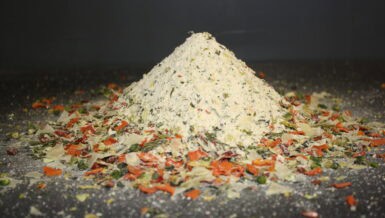
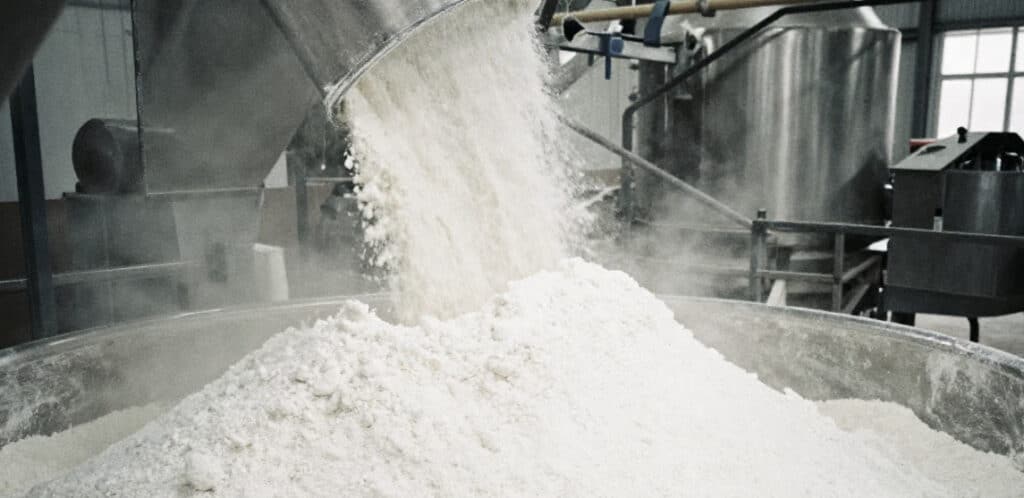
When powders are poured into bins, silos, or IBCs, material often forms a conical heap. As particles roll down the surface of this heap, subtle sorting can occur. Larger or denser particles may travel farther downslope, while lighter or finer fractions remain closer to the point of impact. Repeated filling cycles or heap collapse amplify this effect, gradually creating layered compositions.
Mitigation strategies for surface rolling
- Equipment design: Introduce fill pipes, drop tubes, or deflectors to reduce surface flow and cone formation.
- Operating conditions: Limit heap height and avoid repeated interruptions during filling that cause surface avalanching.
- Blend optimisation: Slightly increase interparticle adhesion or apply granulation to suppress rolling-driven separation.
Size-Driven Separation (Sifting and Percolation)
Percolation segregation occurs when smaller particles fall through the voids between larger ones. This effect intensifies when particle size ratios are large and when the powder bed is repeatedly expanded, such as under vibration or intermittent conveying.
During discharge, non-uniform flow patterns can accelerate percolation. Active flow zones move first, while stagnant regions remain in place, allowing fines to migrate downward. In pharmaceutical or specialty chemical applications, an active ingredient may gradually concentrate at the bottom of a container if it is sufficiently fine and free-flowing.
Importantly, fine particles are not always cohesive. Crystal structure, surface chemistry, coatings, and moisture sensitivity all influence whether fines flow freely or bind together. Segregation can also emerge when fragile agglomerates break apart during handling, releasing fines that were previously immobilised.
Mitigation strategies for sifting
- Equipment design: Use mass-flow hopper geometries, inserts, or flow conditioners to eliminate stagnant zones.
- Operating conditions: Minimise vibration, reduce drop heights, and avoid unnecessary stop–start cycles.
- Blend optimisation: Narrow the particle size distribution, reduce loose fines, or apply granulation to lock components together.
Air-Driven Separation: Fluidisation and Dusting
Air plays a major role in many segregation problems. During rapid filling or discharge, air can become trapped within the powder bed. If the material has low permeability, this air escapes unevenly, locally fluidising fine or light particles and causing them to migrate.
In dry food mixes containing sugars, starches, and flavourings, this mechanism can shift flavour intensity across packages. Transient air pockets during hopper discharge often push fines upward, altering composition even when the bulk flow appears stable.
Dusting represents a related but cumulative effect. Ultrafine particles may be selectively lost through entrainment over time, gradually shifting the blend composition and tightening specification limits.
Mitigation strategies for air-induced segregation
- Equipment design: Provide adequate venting, deaeration paths, and effective dust extraction at critical transfer points.
- Operating conditions: Control fill rates, avoid dumping actions, and prevent pressure fluctuations.
- Blend optimisation: Reduce ultrafine content or apply light surface treatments if the flow window allows.
Momentum and Impact Effects (Trajectory Segregation)
When powders fall freely or are conveyed through air, particles follow different trajectories depending on mass, shape, and aerodynamic drag. Heavier or more compact particles tend to travel farther, while flakes or irregular shapes experience greater air resistance and land closer to the feed point.
In metal powder handling, this effect can cause alloying elements to concentrate unevenly across a hopper bed, compromising feed consistency during compaction or additive manufacturing.
Mitigation strategies for trajectory effects
- Equipment design: Install spreader plates, baffles, or fill lances to distribute impact energy evenly.
- Operating conditions: Reduce drop heights and feed velocities to limit ballistic separation.
- Blend optimisation: Improve density and shape matching or granulate fines onto carrier particles.
Diagnosing Segregation Through Laboratory Testing
Effective control starts with measurement. Basic characterisation includes particle size distribution, true density, bulk density, and cohesion indicators. To go further, segregation should be evaluated directly using test methods that replicate the suspected mechanism.
Flow properties provide critical context. Shear testing quantifies flowability and consolidated strength, while wall friction data supports hopper and chute design. Although these tests do not measure segregation directly, they explain behaviours such as dilation, arching, ratholing, or flushing that often trigger separation.
Where environmental conditions vary in production, testing under controlled humidity and temperature improves predictability. Linking segregation indices to flow behaviour and specific handling steps allows engineers to identify the true root cause rather than relying on trial-and-error adjustments.
Preventing Segregation Across Industries
Different sectors face different dominant risks.
- Pharmaceutical production benefits from controlled granule size, limited transfers, and stable conditioning.
- Food processing prioritises gentle filling, air management, and robust dust control to protect flavour uniformity.
- Metallurgical and battery materials rely on controlled vibration, stable feed density, and blends that resist separation during dosing.
Across all industries, the core principles remain consistent: minimise unnecessary motion after mixing, limit free fall and vibration, and align particle properties wherever feasible. When alignment is not possible, equipment and operating conditions must be designed so that the dominant segregation mechanism cannot express itself.
From Troubleshooting to Predictable Control
Powder segregation is governed by repeatable physical mechanisms, not randomness. Once the dominant pathway—whether percolation, fluidisation, dusting, trajectory effects, or surface rolling—is identified, targeted interventions become possible.
By combining laboratory data with informed equipment design and operating strategies, engineers can move from reactive problem-solving to stable, repeatable performance. Uniformity then becomes a controlled outcome, not a matter of luck.