


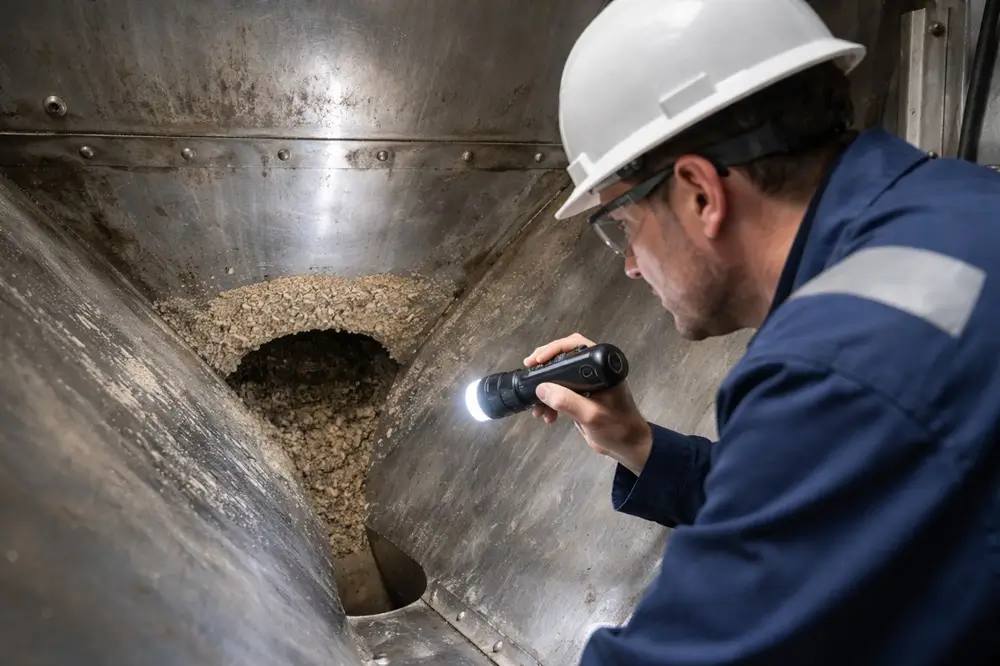
This article explains force networks in bulk solids in practical engineering terms. The goal is to help you recognize the failure signatures, interpret test results with the right caution, and choose interventions that reduce sensitivity to internal force network behavior.
What are force networks in bulk solids
A bulk solid carries load through particle contacts. Most contacts carry little force. A smaller fraction carries most of the stress. Those high load paths form force chains, or force networks, that transmit stress through the bed and into the walls. Two points matter in plant systems. First, stress distribution is highly uneven. One zone may consolidate strongly while a neighboring zone remains lightly loaded. Second, the network is not fixed. It evolves with residence time, moisture, wall condition, and operating stress. Small shifts can change where stress concentrates, especially near the outlet. That is why the same silo can alternate between stable discharge and instability without obvious changes in throughput or equipment power. Force networks become most visible during transitions. Startup after storage, step changes in feed rate, and changes in head height all force the bed to reorganize. If the network collapses and reforms smoothly, flow stays stable. If it locks into a stable structure, you see arching, ratholing, or pulsing.
Failure signatures that point to contact scale control
Several symptoms are strongly consistent with force network-driven behavior.
- Failure after time at rest: the bin ran fine during turnover, then blocks after a hold.
- Intermittent discharge or pulsing: flow alternates between fast and slow, often mirrored in feeder load.
- Ratholes or stable channels: an active flow path forms while surrounding zones remain stagnant.
- Sensitivity to fill level: problems appear at specific head heights or disappear when the level in the silo is low.
- Unexpected wall effects: performance drifts after cleaning cycles, liner wear, or product buildup.
- Related mechanism: Permeability collapse in hopper discharge can stabilize ratholes and trigger surge cycles.
These patterns point away from simple capacity limits and toward internal stress state, wall slip behavior, cohesion, and consolidation history. That is the operating domain of force networks in bulk solids.
What strengthens force networks
Consolidation and time at rest
Time under load increases the contact area through creep, plastic deformation, and moisture redistribution. Strength rises and elastic recovery drops. The contact network becomes more persistent, so higher stress is required to break it during discharge. This is why weekend holds and long storage cycles correlate with sudden arching risk.
If time at rest is part of the trigger, treat time consolidation testing as a design input, not an optional diagnostic. Further reading: Hopper bridging, why one hopper always bridges first.
Wall friction and tangential resistance
Tangential forces resist sliding at contacts and along the wall. Higher friction stabilizes contact networks and promotes shear localization. In funnel flow conditions, stagnant zones preserve consolidated networks that can support stable ratholes and arches.
Wall friction is not constant. It changes with normal stress and with surface conditions. Abrasion, polishing, fouling, and cleaning cycles change roughness and adhesion. If your system relies on marginal wall slip, performance drift over months is a predictable outcome.
Cohesion from fines and moisture
Cohesion becomes decisive when surface forces rival the forces that promote rearrangement. Fine powders sit closer to that boundary. Moisture can push them across it.
Capillary liquid bridges form when moisture condenses at contacts or redistributes during storage. The key is not only total moisture content. Threshold behavior matters. A small change in humidity can shift the material into a regime where bridges form easily, raising unconfined yield strength and stabilizing arches.
Cohesion also changes with fines generation. Attrition during conveying and handling increases surface area and amplifies cohesive behavior over time.
Electrostatics as a modifier
Electrostatics can increase apparent cohesion for fine, insulating powders handled at low humidity and high velocities. Plants often first notice this through adhesion, dust accumulation, and inconsistent filling behavior. Electrostatics rarely acts alone. It interacts with moisture, fines, and wall condition, which is why it often appears as instability that “comes and goes.”
How lab measurements translate to plant behavior
Shear cells, wall friction tests, and compressibility tests remain the right foundation. The mistake is treating them as exact predictors of dynamic discharge. Most lab measurements represent averaged behavior under controlled stress paths. Plant systems introduce stress gradients, transients, boundary effects at the outlet, and time dependent consolidation.
Use lab results as bounds and inputs, not guarantees.
- A flow function indicates relative flowability at defined stresses. It does not promise stable discharge across all operating states.
- A wall friction angle measured on a clean coupon may not represent a worn or fouled wall at plant-scale stresses.
- A short consolidation step may miss strength growth that dominates after storage.
When plant failures persist despite acceptable test results, check three alignment points before changing hardware.
- Stress range alignment: do your test stresses match the stress state near the outlet and along the wall.
- Time alignment: did you test time consolidation at relevant residence times.
- Environment alignment: did your sample conditioning reflect humidity, temperature, and fines state.
This framing keeps force networks in bulk solids tied to actionable interpretation rather than theory.
Practical design and operating moves
Force networks will always exist. Your goal is to prevent them from becoming stable, load-bearing structures that block flow. These moves reduce sensitivity.
- Outlet sizing and geometry
- If arching is the failure mode, increase outlet size where it matters most, at the stress concentration zone.
- Favor mass flow geometry when the duty justifies it, especially for cohesive or time-sensitive materials.
- Wall selection and surface control
- Select wall materials or liners with stable friction behavior under abrasion and expected stress.
- Plan for surface drift. If performance depends on low wall friction, treat inspection and maintenance as part of design.
- Extraction pattern and feeder interface
- Promote uniform extraction across the outlet. Localized extraction promotes shear localization and network locking.
- Avoid operating regimes that encourage stable stagnant zones above the outlet.
- Residence time and inventory strategy
- If hold time triggers failures, reduce residence time, cycle inventory, or limit static head height where feasible.
- Validate any flow aid, aeration, or vibration approach against cohesive strength and stress state.
- Environmental control and conditioning
- Control humidity when moisture-driven cohesion dominates.
- Manage electrostatics through grounding, humidity strategy, and material choices, then verify with plant observations.
About Delft Solids Solutions and PowderTechnology.info
Delft Solids Solutions (DSS) is an independent bulk solids testing and consultancy group that helps industry to understand powder technology-related challenges and quantify powder behavior, troubleshoot flow problems, and support storage and handling design decisions using validated test methods and engineering interpretation.
PowderTechnology.info is an independent technical publication for engineers working with powders and bulk solids. It translates mechanisms such as force networks in bulk solids into measurement guidance and practical decisions for process design, QA, and troubleshooting across multiple industries.